Developer: Ninja Theory
Publisher: Capcom
Played on: PC
Release Date: January 24, 2013
Played with: Dualshock 4
Paid: $9.01 (Multi-game bundle)
It feels impossible to talk about DmC: Devil May Cry without mentioning the discourse surrounding its release. In what felt at the time to be a trend-chasing move, developer Ninja Theory reinvented the wise-cracking, pizza-loving, white-haired protagonist of Dante into a darker, edgier, and possibly smarmier iteration. The fan backlash was swift and immense, with the redesign being widely mocked and reviled. Then when the game came out, many fans derided the changes that were made to gameplay and generally left feeling sour. Flash forward 11 years, and I decided to dive headfirst into this mire for my first experience with the Devil May Cry series. And what I found was a game that, while flawed, was off-the-wall enough to keep me glued to the screen and thinking about it long after I finished playing.
Story-wise, the game is pretty thin. There’s a villain named Mundus who claims he’ll control the world through debt, and then never really elaborates on what that means, but hey, I’m here for the anti-capitalist sentiment. Then we flash over to Dante, living out of a trailer and being woken up in the nude by a woman named Kat. Kat warns him that he’s attracted the attention of a demon, who subsequently drags Dante into the distorted reality known as Limbo. After defeating the demon, Kat tells Dante of the secret society she’s a part of with Dante’s brother, Vergil, and after the three meet up, they set out to take down Mundus once and for all.
To say there’s a plot in DmC is maybe giving it too much credit. It feels more like a series of events strung together to get Dante and co. from one setpiece to the next. Frankly, that’s fine with me in an action-focused game like DmC. I don’t need complex backstories for all the baddies I’m slicing and dicing; it’s enough to know that Mundus is bad and needs to be stopped, and there’s a bunch of visually interesting punching bags in between that goal and I. That being said, I have to bring special mention to the campiness of the dialogue here. While expository scenes can drag a bit, some of the one-liners are so stupid I couldn’t help but smirk. I know Dante’s quips got a lot of flak back in the day, especially a scene where him and a succubus just yell “F*CK YOU!” back and forth at each other, but I found it goofy in a charming way. Also, “I’m your prom date, you ugly sack of sh*t!” is a line that’ll live rent-free in my head for the foreseeable future.
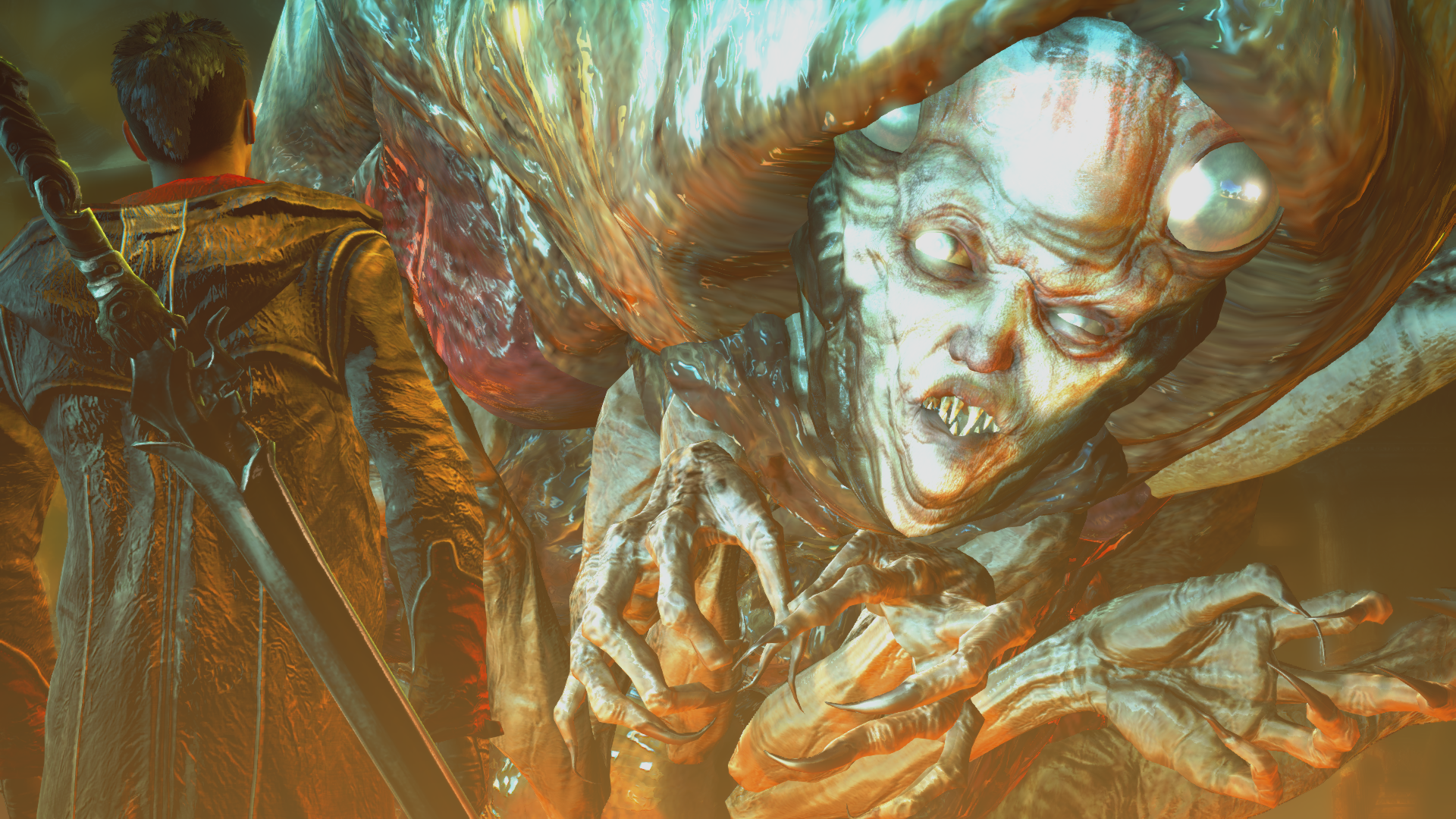
When the cutscenes are done and dusted, though, the gameplay is what really matters, and oh boy, this is some tight gameplay. For starters, I loved playing this game with a controller; switching from standard to angelic and demonic weapons is bound to the triggers, and having a different weapon and attack style be a simple trigger hold away made the combat feel so fast and fluid. I’m sure there’s a suitable alternative when using a mouse and keyboard, but I honestly can’t imagine going back to it. This also allows DmC to get an impressive amount of mileage out of what amounts to two attack buttons, plus a grapple. You use your demonic grapple to pull a flying enemy down towards you, hack away at them for a bit, launch them into the air, and then use your angelic grapple to pull yourself towards them and continue the onslaught. I’ll be the first to admit that I’m a complete neophyte when it comes to this style of game, and I kept a lot of the more advanced combos locked in the upgrade screen so I wouldn’t get overwhelmed with options. Yet even I – the person who would regularly forget about a particular move for half an hour – was able to pull off fun combos like launching an enemy into the air, grappling up to them, slashing around for a bit, and slamming them into the ground. This is all tracked by a combat rating system that encourages you to vary up your moves to achieve higher rankings, though the fact that I was regularly achieving top-tier rankings does make me a bit suspicious of its validity. Sure, I’ll happily take the dopamine hit, but when a button-mashing noob like me can achieve S-rank and higher, I can’t help but wonder if maybe it’s a bit too generous.
Certain enemy types do break up the standard flow of combat, though, and it’s here where things falter a bit. For starters, there are blue- and red-coloured enemies that can only be damaged by angelic and demonic weapons, respectively. These tend to just be a bit tedious, as you’re not able to vary up your attacks as much and engage in the full range of combat options available to you. In an attempt to make the combat more strategic, these enemies neuter the flow of a game that was never asking for deep strategy in the first place. The worst offenders, though, are the Dreamrunners and Drekavac, both of which are agile foes capable of blocking most of Dante’s attacks. Generally speaking, the only way to defeat these is to wait for a specific opening that allows you to get hits in. It grinds combat to a complete halt, and I began to dread them showing up not because they were tough per se, but because they killed my combos and took forever to dispatch.
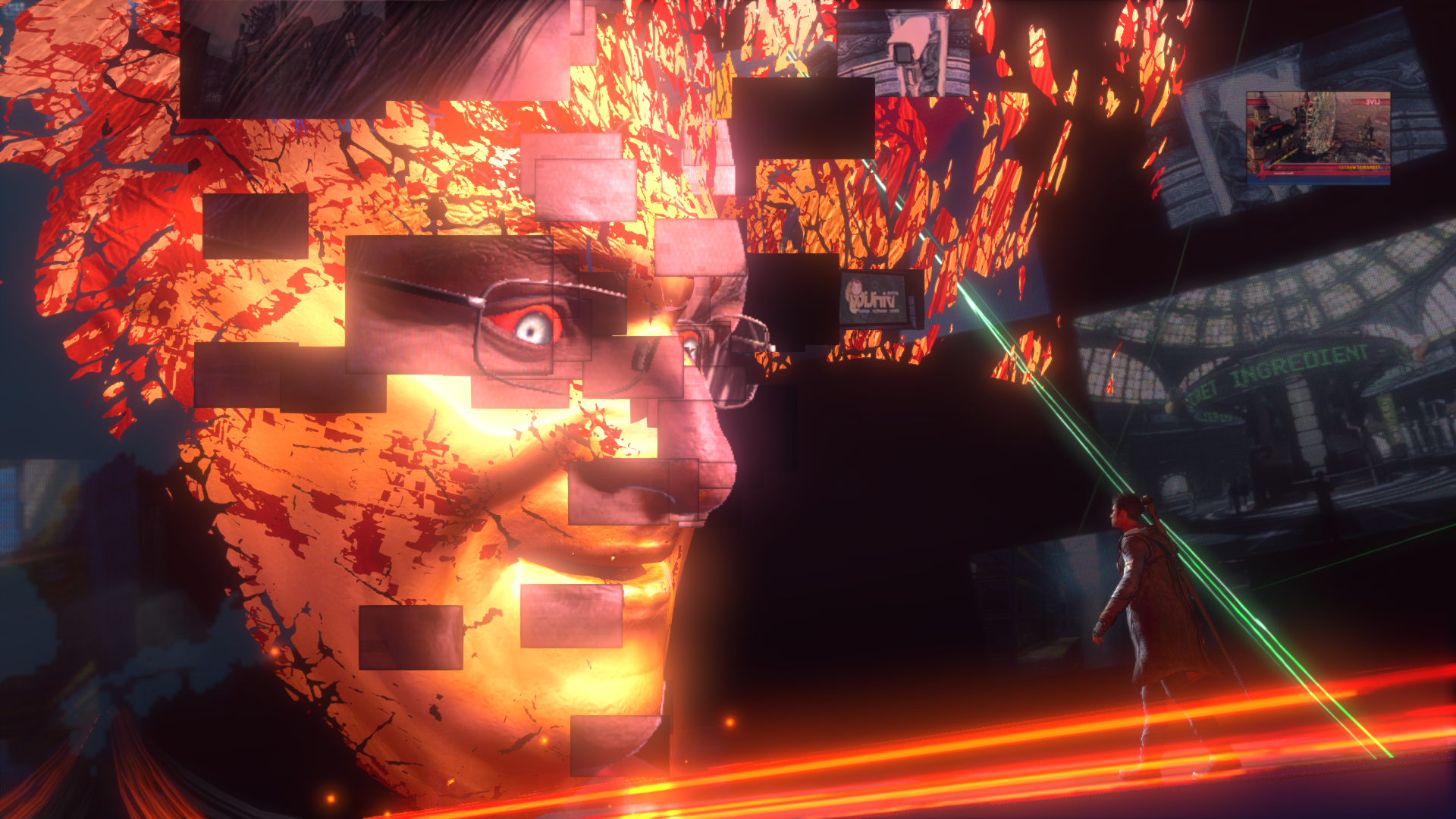
Boss fights are a similarly mixed bag, with about half of them being underwhelming, either from a design or gameplay perspective. For instance, a mid-game fight against a giant fetus in a nightclub (trust me, it…sort of makes sense in context) boils down to repeatedly grappling onto weak points and slashing away at them until the boss “resets” and you have to hit the same points all over. The pumping music and strobing visuals at least make the affair a spectacle, but the actual gameplay is thoroughly tepid. However, the bosses that hit do so exceedingly well. The aforementioned succubus fight forces you to grapple between platforms to dodge acidic bile and devastating smashes, before culminating in a frantic chase down a river as you attempt to finish off your foe once and for all. The highlight of the game, however, is easily the fight against Bob Barbas, host of the Fox News-alike Raptor News. First of all, it’s just great from a spectacle point of view, with Bob’s giant pixelated head sneering and cackling at you from the centre of the arena while you run around dodging attacks and hitting weak points. Once he’s weakened, though, the fight cuts to an overhead helicopter view of Dante fighting hordes of minions, which you retain control for, all while Bob’s snide commentary plays over the “clip”. It’s wacky, weird, and yet plays really well, and I wish more of the centrepiece fights were like it.
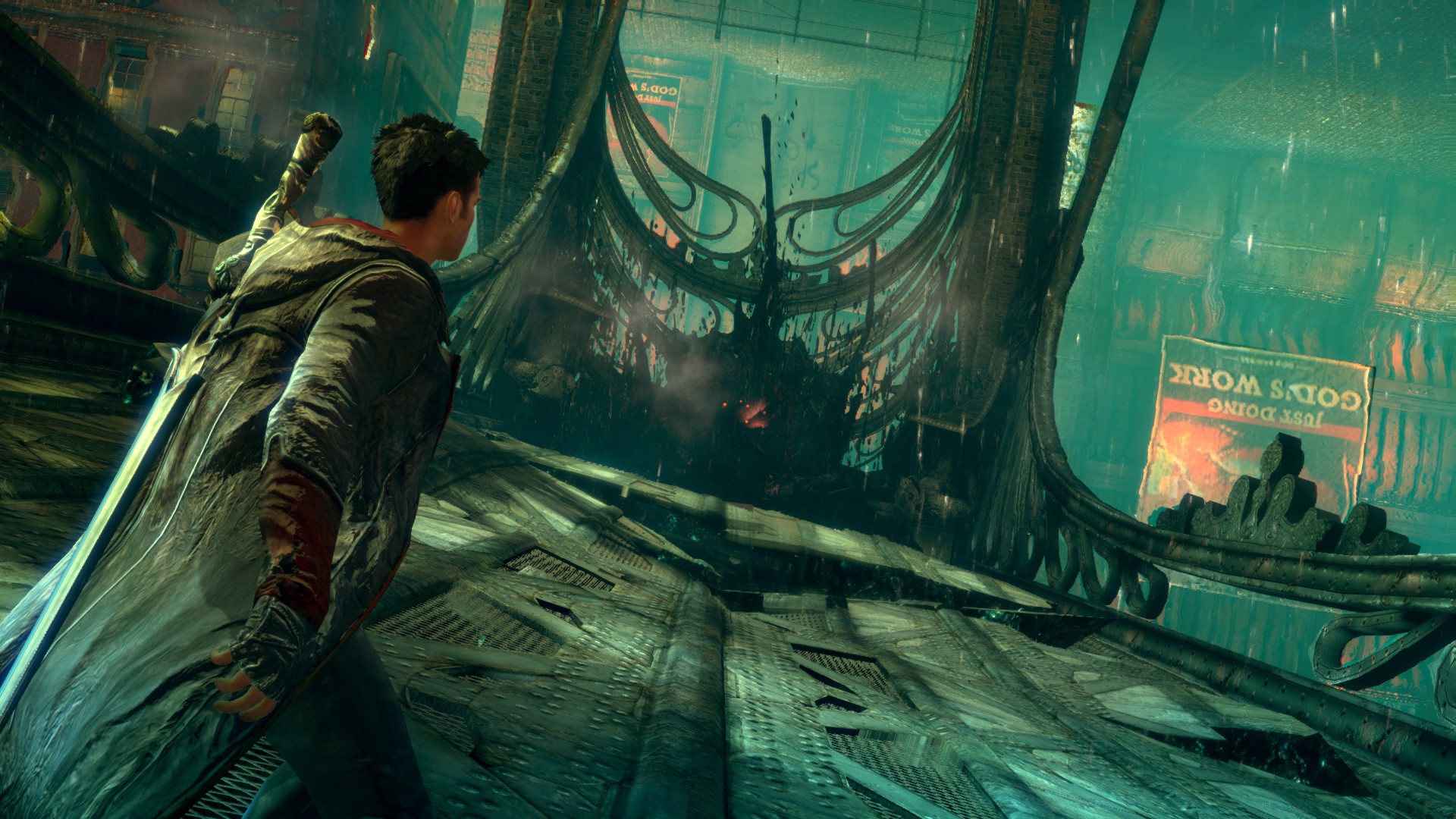
Presentation-wise, I think DmC holds up remarkably well for a decade old game thanks to its art direction. The drab grayness of the real world is contrasted against the warped, ever-changing plane of Limbo, where bright colours abound, sidewalks ripple like waves, buildings close in around you, and bold text appears on walls and floors, read out by a disembodied demonic voice. It makes each level into a unique spectacle, whether you’re traversing winding bridges on the way to an evil news tower, or cutting down foes in a demonic nightclub. Meanwhile, though the pulse-pounding soundtrack isn’t something I’d listen to on its own (I watched the credits all the way through and found the music to be insufferable, particularly lyrically), it compliments the manic hack and slash action of the game and consistently made me feel badass, even when I was clearly fumbling around mashing buttons and hoping for the best.
So it is that DmC: Devil May Cry is a land of contrasts. The threadbare narrative is set against the backdrop of a world that makes me wish there was more to see and do. Combat and boss battles are great until certain opponents grind it to a halt and make things tedious. Yet on the whole I enjoyed my time with DmC. Its frenetic gameplay remains enjoyable throughout the runtime, and makes me intrigued to try other entries in the series. I’m not sure I will, due to hearing that the skill floor is higher and being a big fan of the more accessible approach of DmC. But for an entry that was so controversial upon release for alienating established fans of the franchise, I think it at least may have managed to bring in someone new.
7.5/10
 Olive's Game Garden
On its own the game was good. The radical departure from the tone of the series (compare Cerberus(DMC3) or Angus(DMC4) pre-fight banter to the rather infamous Succubus).
The… Badly handled creators-fans communications didn’t help. The (ironic in hindsight) mop scene didn’t help either. It felt like something along the lines of “the old Dante was shit and you shouldn’t have liked him, and you better deal with the fact that the new, BETTER, one is here to stay”.
The added (slight) departure from the gameplay (no lock on (which was added in later) colour coded enemies) and the perceived ease of getting best style ranking just added to the already burning fires.
I personally feel that it it wasn’t a reboot that “was supposed to kill of the old games” (as it could have been perceived) but a separate have with a ton of references, it would have been celebrated, instead of being reviled.
LikeLike