Developer: TT Games
Publisher: Warner Bros. Games, Warner Bros. Interactive Entertainment
Played on: PC
Release Date: April 5, 2022
Played with: Dualshock 4
Paid: $18.89 (Galactic Edition)
Lego Star Wars is pure nostalgia for me. As a kid, I was obsessed with the Star Wars franchise, but since the movies were deemed too intense for little ol’ me, playing Lego Star Wars at friends’ houses was my way of experiencing the galaxy far, far away on a TV screen. I distinctly remember staying up “way too late” (it was probably only 1 am or so) working through episode one in co-op with my friend, trying to grind out levels and money to unlock cool villains like Darth Maul and, eventually, General Grievous. Back in those days, the two trilogies of films actually got released as separate games, before eventually being united in Lego Star Wars: The Complete Saga. Fifteen years and three additional films later, Lego Star Wars: The Skywalker Saga is a game that would have made kid-Olivia’s head explode. It’s not just the sheer breadth of content on offer, but the presence of “open world” areas allowing free-range exploration of various iconic locales. Hell, knowing when to stop and write this review has been difficult to judge, as the game’s wealth of collectibles give it a certain magnetism that keeps bringing me back, even after completing all nine episodes. That said, 61 hours of playtime at time of writing is certainly nothing to sneeze at, so let’s see how The Skywalker Saga shakes out.
Narratively, The Skywalker Saga tells abridged versions of the nine mainline Star Wars films, with a healthy dose of humour scattered throughout. Sure, there’s the classic tales of heroes and villains, light and dark, and good and evil, but there’s also “I ❤ Darth Vader” t-shirts, bribing Chewbacca with cookies, multiple dance sequences, and a ton of slapstick. Thankfully, any reference-based humour is constrained to the source material, keeping it from feeling dated with memes or other pop culture references. However, there are times where the constant levity meshes poorly with the serious parts of the narrative, with some death scenes in particular eliciting more of a nervous chuckle than a full-blown laugh. I also don’t think these retellings are particularly friendly to anyone completely unfamiliar with the original stories; sure, kids may get a kick out of all the goofiness, but to anyone else things will likely feel incredibly loose and disjointed. That being said, I think there’s a lot to love here, whether you’re a hardcore Star Wars fan or have just seen the movies once or twice. Hell, it even manages to make episode nine fun, which is more than I can say for the film itself.
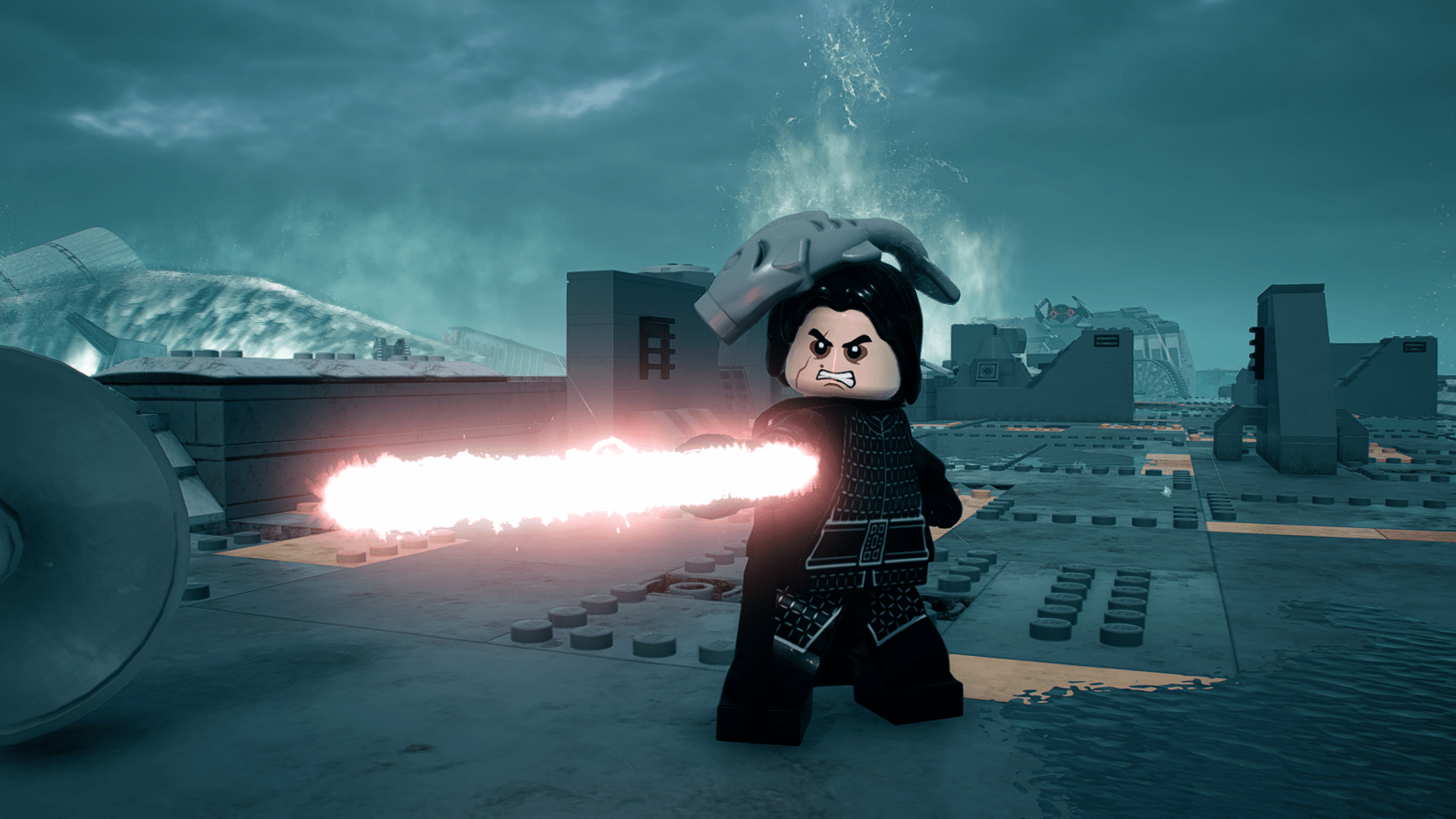
Each episode in The Skywalker Saga is split into five discrete levels, with cutscenes and free-roaming sections interspersed throughout. The level structure should be pretty standard fare for fans of past Lego games: you complete a series of objectives in the form of puzzles or fights, all while collecting studs (the game’s currency) and hunting around for minikits, some of which are inaccessible to the characters you’re playing with. This instalment also adds three secret challenges to each level that can be completed for an additional reward, such as defeating a boss in a certain amount of time, or shooting the helmets off a number of Stormtroopers. After completing a given level once, you’re able to return in free play mode, where you have access to all the characters you’ve unlocked during the game and can use them to mop up any remaining collectibles. The structure works well – if you want to power through the level just to unlock free play, that’s a viable option. Yet the game constantly teases you with glimpses of collectibles just out of reach, encouraging you to engage with the slightly more esoteric puzzles to collect them. I think that making the level challenges a secret was a mistake, though, because half the time, I’d get a pop-up saying I completed one with no clue what I had actually done to earn it. Thankfully, you can spend studs to unlock “rumours” for all collectibles, which in the case of the challenges are (occasionally vague, but often helpful) hints as to their completion conditions. However, it’s an extra step that penalizes the player for not reading the developers’ minds. Those studs could be better spent on unlocking characters, upgrading character classes, or buying rumours for collectibles like Kyber bricks.
Kyber bricks are the main thing you’ll be hunting around for in The Skywalker Saga, particularly in the open-world sections. These parts drop you into a large map and give you free reign to explore around, chatting up NPCs, solving puzzles, and accepting side missions. They also usually unlock the character selector from the beginning, so there’s no limits on using the characters you’ve acquired to solve class-specific puzzles, even if you’re in the middle of an episode. There are even helpful icons that pop up in front of objects requiring a particular class ability to interact with them. However, one frustrating thing is that the Scavenger class’ abilities aren’t unlocked at the start of the game, and yet there’s no indication of this whatsoever. Objects still get highlighted with the Scavenger icon, but switching to a character with that class doesn’t let you do anything. I actually had to do online research in order to learn that they’re acquired through story progression, and I wish there had been more in-game indication of this.
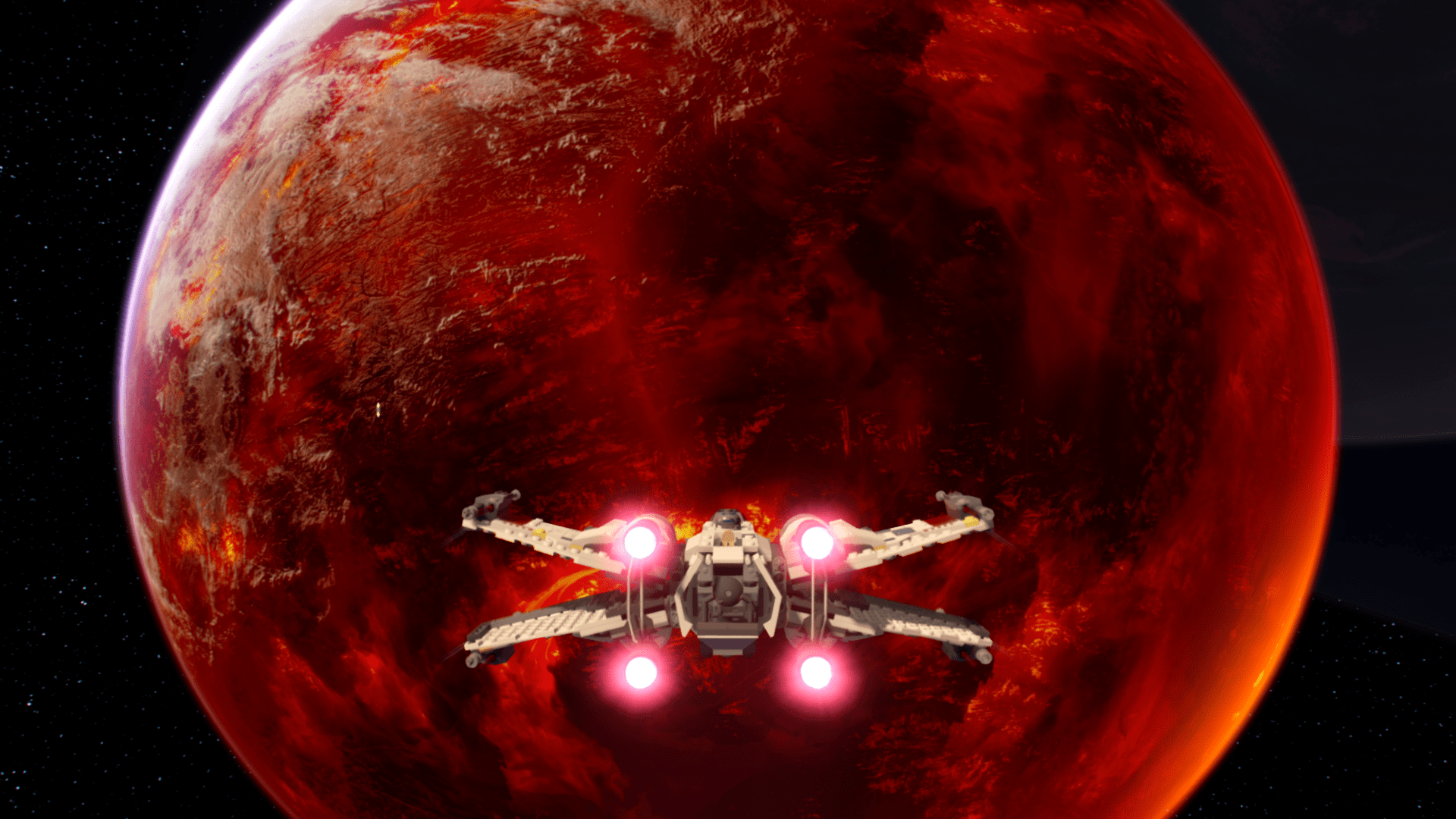
Otherwise, I found the free-roaming sections to be extremely easy to get lost in, especially after unlocking the upgrade that highlights all collectibles in the area. Dropping in and seeing dozens of markers pop up felt like being a kid in a candy store; who cares about the main plot when there are all these goodies to be found! The game rewards you with Kyber bricks for doing everything from platforming challenges to shooting galleries; it actually reminded me a lot of Super Mario Odyssey’s approach to handing out moons. Those bricks can then be spent to upgrade character classes, whether it’s increasing health and damage output or giving a discount on purchasing rumours. Once again, it’s easy to just jump from plot beat to plot beat if you prefer that, though usually that involves simply walking from point A to point B. It feels a bit underwhelming and makes the open-world areas less interesting. I wish these sections played into the plot a bit more, giving greater incentive to explore the world instead of just running from waypoint to waypoint. Some of the side missions have you hopping from planet to planet to gather resources or smuggling goods while participating in space battles, and it would have been great to see more of that in the free-roaming story sections.
Gameplay is fairly simple, though sometimes to its detriment. At least while playing with a controller, The Skywalker Saga is a victim of mapping too many things to the same button. For instance, as a Jedi, pressing the B button will sheath your lightsaber, while holding it will let you use the Force to levitate a nearby object. However, if there’s a valid object in range, pressing the B button can instead do a Force push, blowing up that object in the process. Additionally, if there’s an NPC in front of you, pressing the B button allows you to talk to them. Overloading one button with so many context-sensitive actions makes it into a bit of a gamble whether you actually get to do what you want right away. I lost count of the number of times I tried to talk to someone and instead threw a boulder at their head, subsequently having to wait for them to calm down before I could attempt to speak to them again.
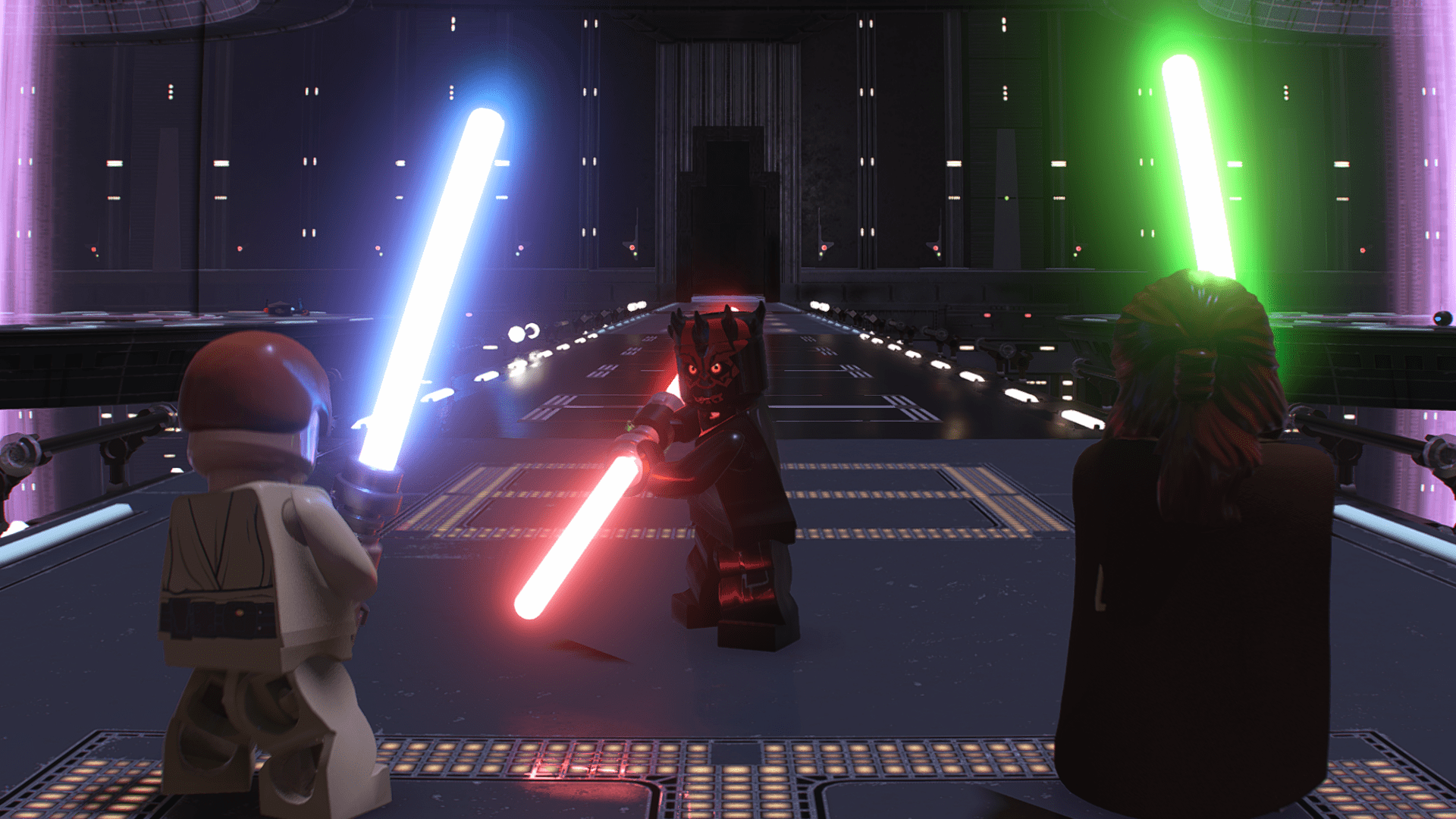
Combat also feels a bit clunky, at least at the outset. There’s a half-baked combo system that never seems to get off the ground due to some attacks naturally flowing into each other while others don’t, often seemingly at random. However, things do get better with later boss battles, as the game adds a dodge maneuver (insert questions about whether Lego Star Wars is now a Souls-like here) and foes that can soak up more damage, making it easier to build up a string of attacks against them. I actually started to enjoy combat by the end of the game, thanks to some epic lightsaber duels as well as fun third-person shooting sections, which was a far cry from my initial impressions.
There’s also a lot of space combat, which could honestly stand to have the difficulty bumped up. Most of the time, I found it easiest to completely slow down my ship and turn in place, acting as a slow-moving turret picking off enemies as they flew by. The enemy AI occasionally hit with a barrage of laser blasts, but it was never enough to seriously threaten my health bar. Epic strafing runs against massive capital ships are definitely possible, yet they often don’t feel necessary, giving the space combat less of an edge compared to what it could have had.
Unfortunately, what impedes the gameplay more than overloaded buttons or overly easy space combat are bugs, and quite a few of them. Climbing and grabbing ledges can be irritatingly unpredictable, with characters sometimes not registering a particular handhold and instead jumping off the wall they’re scaling. The game didn’t register that I had destroyed a specific ship, so I kept getting the same lines of dialogue from the pilot over and over again while I was in the area. A tooltip got stuck displaying on the screen and wouldn’t disappear until I completely shut down the game. Some collectibles either showed up on the HUD, but not on the map, or vice versa. A minigame involving using the Force to play basketball (yup, that’s a thing) stopped registering the ball going into the hoop, making clearing the game and earning the associated Kyber brick impossible until a later attempt. Finally, there was a section of a level where the music got oddly tinny, as well as one full-blown crash to desktop, which thankfully didn’t cause me to lose much progress. I wouldn’t be surprised if a lot of these problems resulted from the reported tumultuous development of the game, including heavy developer crunch: a distressingly common practice in the big budget game scene. Despite these issues, I would say that the bulk of the experience feels fairly stable, but it does mean that when glitches crop up, they stick out like a red lightsaber at a Jedi party.
The presentation is at least on point. I mentioned that the music went tinny during one level, but that was only noticeable due to how high-quality it was everywhere else. Most of the music is pulled from the original John Williams scores for the films, with some original tracks thrown in for good measure, and it really brings the universe to life. Additionally, there’s some quality voice acting, which includes big names like Anthony Daniels reprising their roles from the films, as well as a host of newcomers covering everyone from the big main characters down to random NPCs. As an added bonus, there’s even a “Mumble Mode” that can be enabled if you prefer the more language-independent presentation of the original Lego Star Wars games, though subtitles are then necessary to know what’s going on. Visually, The Skywalker Saga is also a treat, with characters and environments rendered with a loving attention to detail. High-quality textures show scuffs, dents, and even mould lines on the smooth, shiny plastic of the characters, and the mix of chunky Lego pieces with realistic foliage and structures in the levels works remarkably well. It also has the nice side effect of making it obvious what objects can be interacted with, taking away a lot of the guesswork in exploration. Sure, it’s not like the game is pushing high-end raytracing or anything fancy like Lego Builder’s Journey, but as an interactive, bricky representation of a galaxy far, far away, it excels.

I’ve spent the bulk of this review being quite positive towards The Skywalker Saga, and yet I told a friend of mine, “Depending on the day, I could see myself giving this anywhere from a 5 to a 9.” That may seem like an odd remark, but the truth is that, despite all that it does right, I was rarely ever excited by the game. It was pretty much the definition of a “vibes game”: one where I wasn’t so much playing to experience a grand narrative or get sucked into deep gameplay systems, but rather because it was pleasant to run around collecting Kyber bricks and unlocking characters for a few hours at a time. So that leaves me in an odd spot when it comes to whether I recommend Lego Star Wars: The Skywalker Saga. It’s a competently made game that hit me at the right place at the right time, and has provided a steady stream of dopamine ever since. However, I don’t think it reaches the universal acclaim that would see me awarding an excellent score like a 9/10. Intermittent bugs and glitches hamper the experience, as well as some wonkiness with the gameplay and obtuseness in the design. I also can’t deny the role that nostalgia is playing in my evaluation; to slap the game with something like a 5/10 would feel like spitting on my childhood, despite the fact that some days it felt more like I was playing the game just to play something, rather than because I was having fun. If it sounds like I’m waffling, it’s because I am, but I guess my hope is that, regardless of the score I give, there’s enough information in this exceptionally wordy review to help you decide if that rating would hold true for you. There’s a lot to love in The Skywalker Saga, and even if it’s not the flawless experience my inner child wants it to be, I think it still showed me enough of a good time to earn a solid
8/10
 Olive's Game Garden