Developer: Hello Games
Publisher: Hello Games
Played on: PC
Release Date: October 7, 2021
Played with: Dualshock 4
Paid: $4.08
The Last Campfire is not the type of game I expected to see from Hello Games. Coming out five years after the disastrous launch of their massive, procedurally-generated space game No Man’s Sky, The Last Campfire feels noticeably restrained in comparison. It’s a small, relatively short puzzle game with a strong emotional core that’s leagues away from the infinite universe advertised by its predecessor. Huge scope has defined Hello Games in recent times (their next game promises “a fantasy planet the size of Earth”), and The Last Campfire has anything but, making it something of an odd entry in their modern catalogue. In this case, though, I think the old adage “less is more” definitely holds true, as The Last Campfire is a wondrous little puzzler that was a joy to play from start to finish.
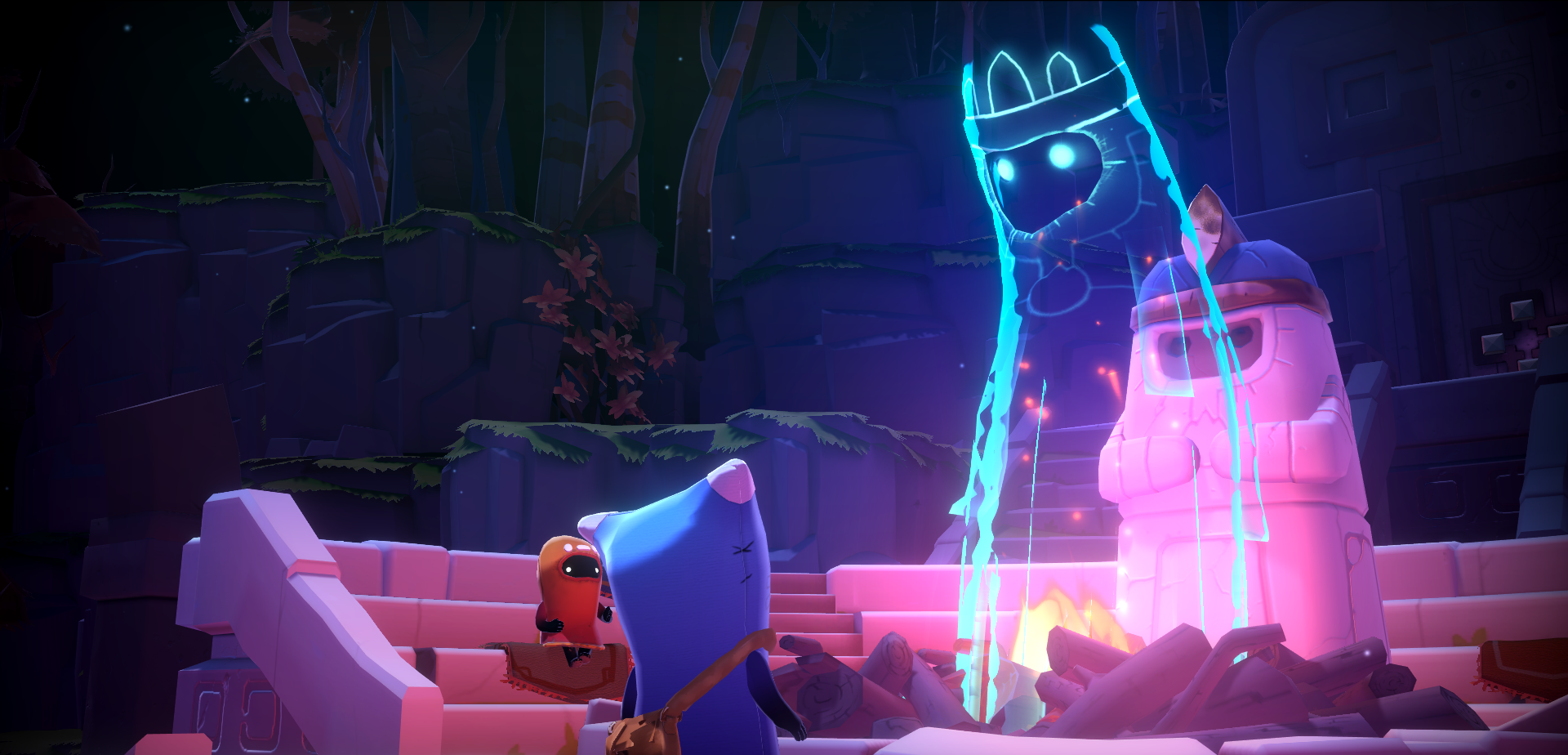
The Last Campfire’s story opens on a character known only as The Wanderer paddling through a cave with a group of similarly-dressed creatures. A momentary distraction causes The Wanderer to lose their paddle and become separated from their group, winding up in what’s only known as “an in-between place”. From here, the perspective shifts to Ember, another of the little creatures (though clothed in blue compared to The Wanderer’s red) awaking in a cave. Ember is similarly lost and confused, but presses on under the watchful eye of The Wanderer, eventually making their way to a campfire. A spirit in the fire informs them of the presence of lost creatures known as Forlorn (beings like Ember who have turned to stone) and tasks Ember with setting out to rescue them. There’s also a mysterious being known as the Forest King, an aged bird who opposes Ember’s quest, telling them to instead remain where they are, safe in the nest the king has created.

The story is told via a singular narrator, who does an admirable job of weaving the game’s narrative together. It feels like being read a bedtime story, despite touching on themes that would probably be deemed too mature for the average children’s book. Depression, nihilism, death, and what comes after are all brought up through the stories of the Forlorn and the overarching narrative, giving this cute, cozy game an at times unexpectedly bleak tone. I even found myself tearing up a bit at the end, and there were several lines that hit surprisingly hard given my own recent struggles.
That’s not to say The Last Campfire doesn’t know how to have fun, though. Cute little piggies, messy mudslides, and giant frogs all add touches of whimsy to the game, along with an absolutely gorgeous visual presentation. The bright colours of the exterior areas and blazing light of the campfires are contrasted beautifully with the dark, gloomy caves and foreboding ruins. Cobwebs cling to Ember as they move through caverns, and mud stains their tunic when they go down slides. Even the rescued Forlorn add spots of colour to the world, clad as they are in a variety of saturated tones.
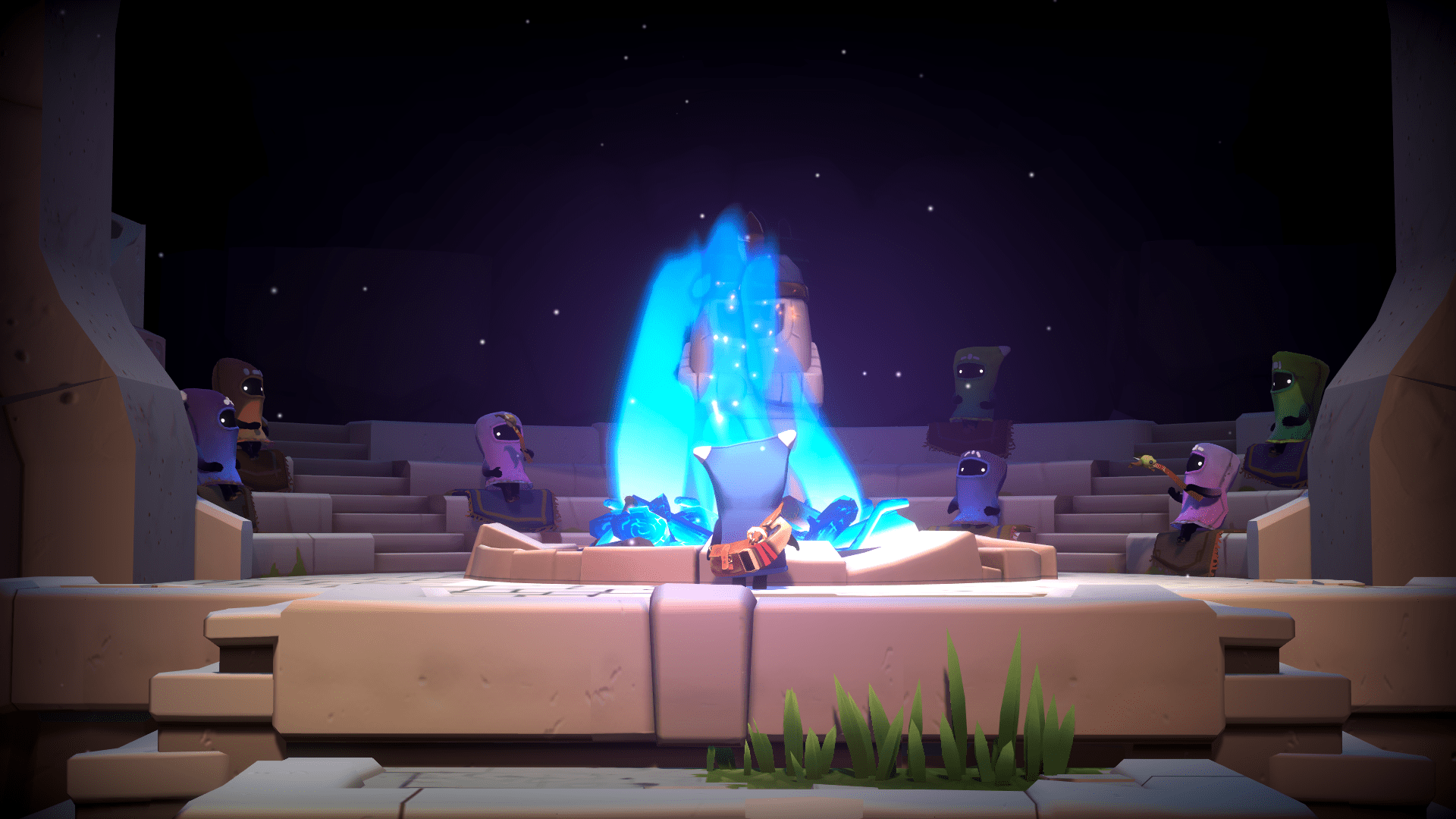
That brings me to the process of actually reviving the Forlorn, which is split into two distinct halves. First, you have to find a way to reach each Forlorn’s statue in the world, solving environmental puzzles that occasionally stretch across multiple areas. There’s even a bit of a hint system in place, where you can return to the region’s campfire and get a clue from the fire spirit as to the location of one of the remaining Forlorn. These can be a bit vague and unhelpful, as the ones I used only told me where the Forlorn was located, not how to get to them, but it’s a nice feature nonetheless. Additionally, hidden chests containing entries from The Wanderer’s journal can be found scattered about the world, each one fleshing out the story and their own experiences further. I found them to be an interesting aside, especially given the different ways The Wanderer would approach or reflect on problems. Thankfully, they aren’t mandatory for progress or achievement unlocks, as some can be quite tricky to get to and easily missed, though the game does inform you of how many are in the area you’re currently exploring. The only thing that’s mandatory for progress is saving a certain number of Forlorn in each area, and even that doesn’t require you to get every one if you just want to progress through the game.
Reaching a given Forlorn means it’s time to reignite their fire by solving a dedicated puzzle room. These use a variety of mechanisms, including reflecting light with mirrors and sliding blocks around to create pathways and activate switches. Each room only uses one or two mechanisms, with the game switching to new ones as you progress, keeping things fresh without radically increasing complexity. I also never found the difficulty to be too severe – at most I got stuck on some puzzles for a few minutes – and yet there were still plenty of moments that made me feel clever. It helps that the narrator continues to feed you bits of backstory about the Forlorn as you solve their puzzle, so getting a new piece of dialogue can be a hint that you’re moving in the right direction. Special mention should also go to the music during these puzzle rooms: despite the same song being used for almost every room in the game, it never got old, instead propelling me through my pensive pursuits. The biggest hiccups were that button prompts occasionally didn’t appear for interactable objects, and it was sometimes easy to get stuck on the terrain, though neither substantively impeded my progress through the puzzles. Overall, playing The Last Campfire was a buttery smooth experience, and exploring its world was a pleasure throughout.
The Last Campfire is a beautiful game inside and out. Its world is a joy to explore, its simple mechanisms feed into elegant puzzles effortlessly, and its narrative touched my heart in ways I never expected it to. While the puzzles won’t burn your brain like some titles in the genre, I think that helps to keep focus on the story, ensuring that the emotional core of the game is never lost under the weight of frustration. There’s truly something special here, and it’s certainly managed to light a fire in my soul like few games before it.
9/10
 Olive's Game Garden