Developer: Campo Santo
Publisher: Panic, Campo Santo
Played on: PC
Release Date: February 9, 2016
Played with: Mouse & Keyboard
Paid: $2.72
Playing Firewatch was a rollercoaster of emotions. For starters, immediately after finishing the introduction, I had to quit out and go lay down. The game’s store page says that the protagonist, Henry, “has retreated from his messy life”, but I wasn’t prepared to learn just how messy that life was. It hit like a tonne of bricks, leaving my head spinning thinking of all the personal pain it brought to the surface. When I finally managed to sit back down with Firewatch, all of that raw emotion from the intro rapidly evaporated, to be replaced with a strange mystery and a gradually ratcheting tension that made me all but forget about the difficult opening. It felt like two separate stories had been smashed together into a strange homunculus of a narrative, and I couldn’t decide which one I hoped would win out to become the focal point. Eventually, though, questions were answered, the mystery was solved, and all the tension disappeared like a plume of smoke in the wind. All I was left with was a sort of hollowness, and the sense that, while captivating, Firewatch missed the mark to becoming truly special.
If there’s one thing that is special about Firewatch, it’s the way it looks. Taking clear inspiration from the Fifty-Nine Parks print series, the Wyoming wilderness is brought to beautiful life in every scene. Lush greenery, blazing sunsets, and babbling brooks all feature in a world that begs you to wander and get lost in it; there’s even a separate free-roam mode available for you to do just that. The minimalist score by Chris Remo also helps, punctuating key moments with atmospheric music that ranges from meditative to anxiety-inducing. Finally, I really can’t praise the voice acting enough. Rich Sommer and Cissy Jones bring Henry and his supervisor, Delilah, to life, and it’s incredible how much they sell the characters. The bulk of the game’s dialogue takes place between Henry and Delilah communicating via walkie-talkies, meaning extra care had to be taken to make the characters expressive and sympathetic when you can’t even see their faces. Despite this challenge, both actors rise to the occasion, and I was invested in Henry and Delilah as people up until the game’s closing moments.
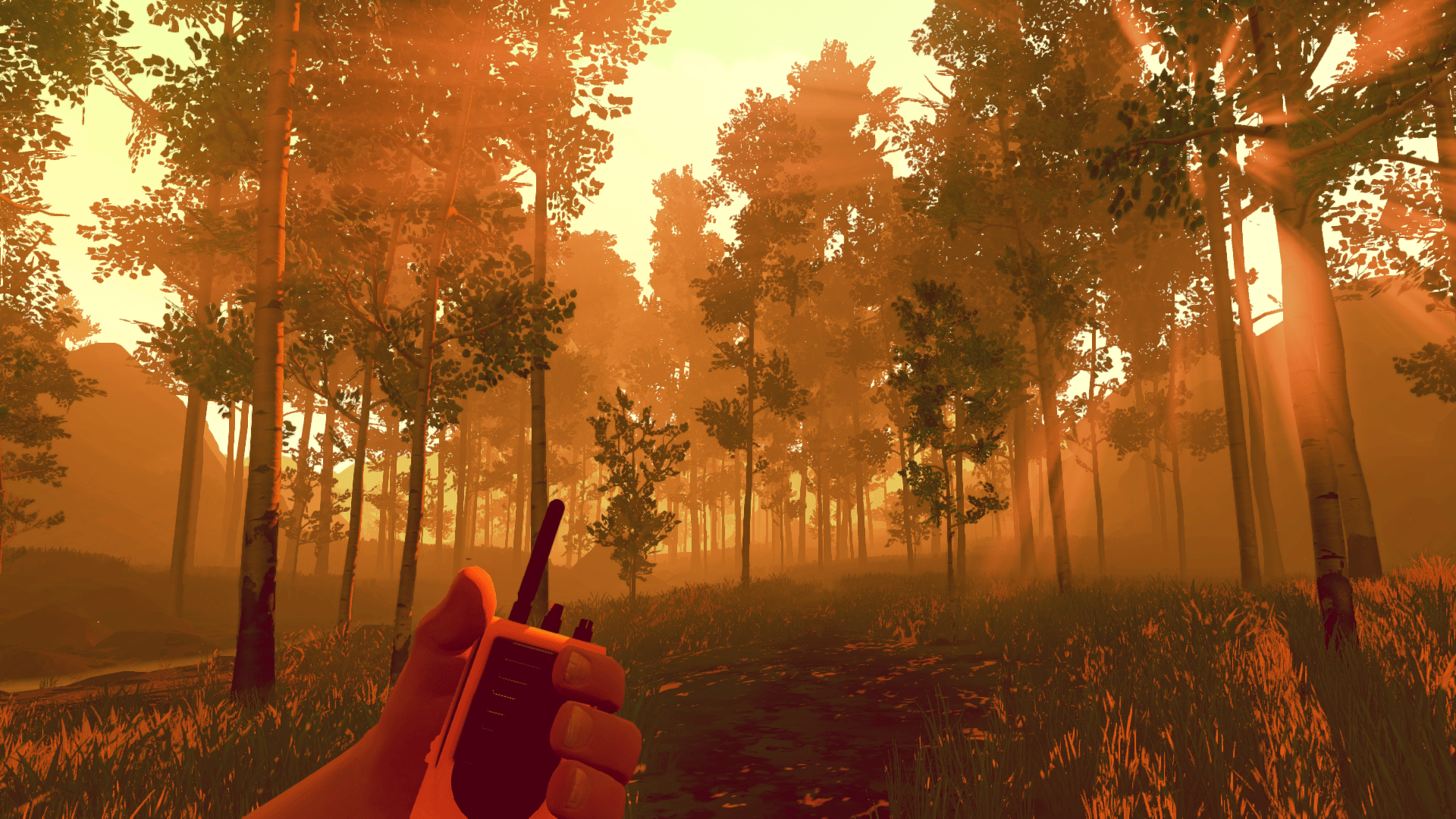
Conversations between Henry and Delilah are what propel Firewatch forward, including a timed dialogue choice system that allows you to select Henry’s replies or even stay silent, something which accidentally happened to me a few times while my nose was buried in the in-game map. Beyond that, though, the gameplay is all about hiking through the woods to get to different areas and complete objectives. Context-sensitive objects can be jumped over or rappelled down, but mostly you’ll be looking at the map and compass to get a heading and following a trail to your destination. Objects can be picked up and carried, though annoyingly you have to drop them each time you want to do something else like tying off a rope or checking your map. At one point I was carrying around a turtle to attempt to get an achievement, and having to constantly toss it on the ground, check my map, and then pick it up again got really old really quickly. I suppose that did feed into Firewatch’s sense of immersion, though, which I did appreciate. I actually turned off the HUD, which occasionally made it more difficult to select what I wanted in the world, but the trade-off was worth it. The fact that your map is a physical object Henry raises up and pores over is a great way to keep the experience front and centre, as opposed to going into a separate menu. There were even times where I was afraid to look at the map for too long, because I was worried something bad would happen while I was distracted.
I did encounter some technical glitches while exploring the woodland: for example, one button prompt to clear some brush kept sending Henry sliding backwards and up into the air, before unceremoniously dropping him on the ground. Walking forward while interacting with the prompt seemed to fix it, but it momentarily made the game’s rising tension disappear. On a similar note, starting to climb a particular rope bugged out, causing the camera to judder in place until I was able to climb a bit higher. In the grand scheme of the experience, they were fairly minor, but they did temporarily break my sense of immersion and were disappointing to see.

I have both a lot and very little to say about Firewatch. I think that it’s a game that’s best experienced with as little prior knowledge as possible, which is why I’ve been so vague on the story details in this review. From a gameplay perspective, it’s also quite simplistic; there’s little more interaction than your average walking simulator, so there isn’t that much to discuss on that front. Yet it’s such a confounding title to me because it soars so high and falls so flat in various places. The introduction stuck with me as I went about my day, making me worry about what sort of challenging subject matter I’d be forced to reckon with as I played further. Then when I sat down to play more, the sense of impending heartbreak was swapped out for impending doom, and I was on the edge of my seat through much of the experience. Finally, the mystery was resolved and the credits rolled, and I was left feeling…empty.
I don’t think that fully negates the experience I had along the way, though. There’s a lot to love, between the gorgeous world, charismatic voice acting, and mysterious writing. The ending might lack the punch of the rest of the game, and the heel turn from the intro to the core game can be jarring, but I can’t shake the feeling that there’s something worthwhile here. Firewatch is a game where the journey is more important than the destination, and for the four hours I spent with it, I can’t say that I regret taking that journey.
8/10
 Olive's Game Garden