Developer: Io-Interactive A/S
Publisher: Io-Interactive A/S
Played on: PC
Release Date: November 19, 2012
Played with: Mouse & Keyboard
Paid: $7.65 (multi-game bundle)
For quite some time, I’ve found myself attracted to the black sheep of franchises. Dark Souls II’s controversial experimentation with the Souls formula caught my attention before I’d even played the first game. DmC: Devil May Cry’s attempted reinvention ended up being my introductory point to the series. Now, Hitman: Absolution is the latest game I’ve looked at that has garnered a lot of attention – both positive and negative – for being different from what came before and after. In Absolution’s case, this differentiating factor is a greater emphasis on storytelling and linear design than is typically synonymous with the Hitman series. But how well did this change work for me, and was it enough to make me a Hitman convert? The answer, as always, is complicated.
The premise of Absolution sees players taking on the role of Agent 47 after his handler, Diana, goes rogue and burns all the existing agents in The Agency, the organization they both work for. 47 is called in to carry out a hit on Diana, but after doing so discovers that she was protecting a young girl named Victoria, who was experimented on by The Agency. Victoria doesn’t stay under 47’s protection for long, though, as she’s quickly kidnapped and held for ransom by a cringey cowboy named Dexter. So begins 47’s long road towards rescuing Victoria, one that will be paved with dozens, if not hundreds of bodies.

The plot in Absolution – despite being a focal point – is unfortunately not the game’s strongest suit. There’s a cast of colourful characters who really only stand out for some terrible one-liners (seriously, why does one of your targets talk about getting wood while on his deathbed?), and for the way that they seemingly drift in and out of the plot at random. One character in particular barely plays an active role in the story, yet keeps popping up, leaving cryptic notes and making shaky alliances with everyone and their dog. The narrative is largely a connecting device to tell you why Agent 47 needs to assassinate everyone from a pro wrestler to a gang of latex-clad nuns, which isn’t a bad thing per se, but it clearly wants to be so much more. There’s shifting allegiances, double- and triple-crossing, fake out deaths, and more, yet none of it feels like it adds up to anything. I was never caught off-guard by any of the twists and turns, rather my reaction was akin to, “Oh, I guess that’s a thing now.”
There’s also tonal inconsistencies, with Absolution unable to decide if it wants to be a serious thriller or a more light-hearted, shlocky comedy. The hardened exterior of 47 and his tale of rescue and revenge are contrasted against the aforementioned, “Why do I got wood?” line and Dexter’s over-the-top cowboy antics to create a game whose cutscenes I’ll probably be skipping if I decide to replay it. The game’s desire for scripted scenes also interferes with the gameplay at times. I ran into an issue where an NPC changed their pathing solely based on my presence in a room, despite nobody seeing me enter said room. It turned out there was a scripted event that triggered if she went into the room first, followed by 47, but that’s not worth completely upending the player’s plans. I also have to mention that, while Absolution was certainly not the only game doing this at the time, it was nonetheless exhausting to play yet another game where homophobic slurs get casually tossed around and basically every female character is sexualized. Hell, they even show Diana’s ass in a shower scene, but don’t have the decency to show Agent 47’s in a later one; truly disappointing.
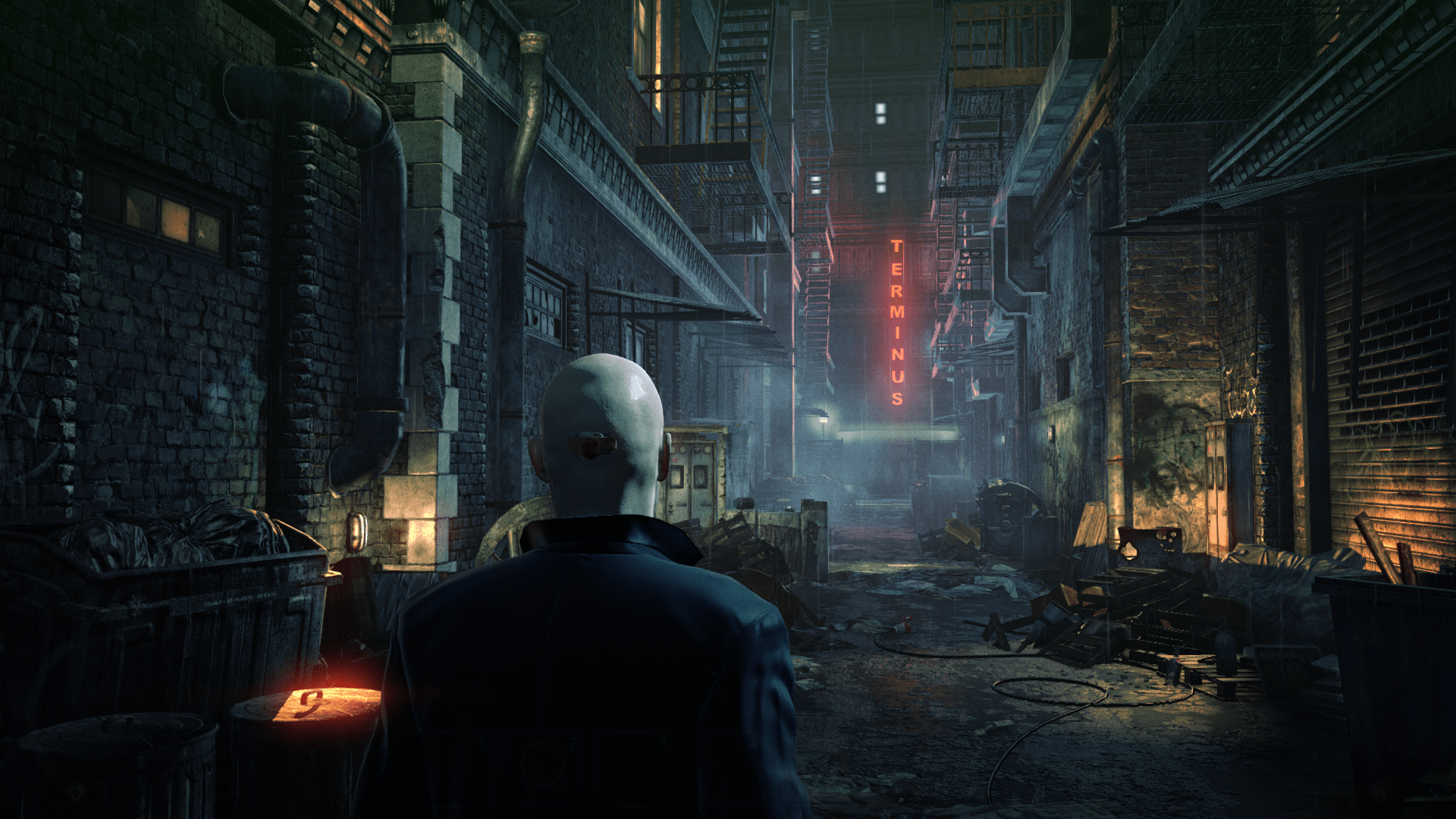
When Agent 47 isn’t denying players footage of his well-sculpted ass, he’s sneaking and shooting his way through a variety of missions, and it’s here where the game starts to open up. Now, for context, I played the game on the normal difficulty setting, meaning guards weren’t as plentiful and features like Instinct could be used more liberally. If you want to go into the comments and call me a noob for that…well, I appreciate the engagement. However, I do think that this setup really allowed me to see the host of features Absolution offers to players, even if they’re not the way the pros play the game. With that out of the way, let’s talk specifics.
Hitman: Absolution features pretty standard third-person shooter movement, including taking cover behind obstacles, vaulting over short walls, and even blind-firing around corners. Added to that are a host of stealth mechanisms, such as throwing objects to distract enemies, hiding yourself and bodies in various receptacles, crawling through vents, and wearing disguises. The disguise mechanism in particular is interesting (and apparently changed from previous entries in the series) in that NPCs wearing the same outfit as you can see through your disguise; in other words, if Agent 47 dresses up like a janitor, he can walk right past a security guard unassailed, but another janitor will immediately report him. This can lead to some fun experimentation in certain levels. For instance, in the game’s courthouse mission, I knocked out and disguised myself as the judge, suddenly having full unrestricted access to all areas of the premises, whereas a security guard disguise would have been seen through easily. In other levels, though, it makes disguises all but useless; lots of areas are populated almost exclusively by random mercenaries, and the fact that they clock 47 in their own attire just as easily as if he’s wearing a suit and tie feels both unrealistic and decidedly unfun.
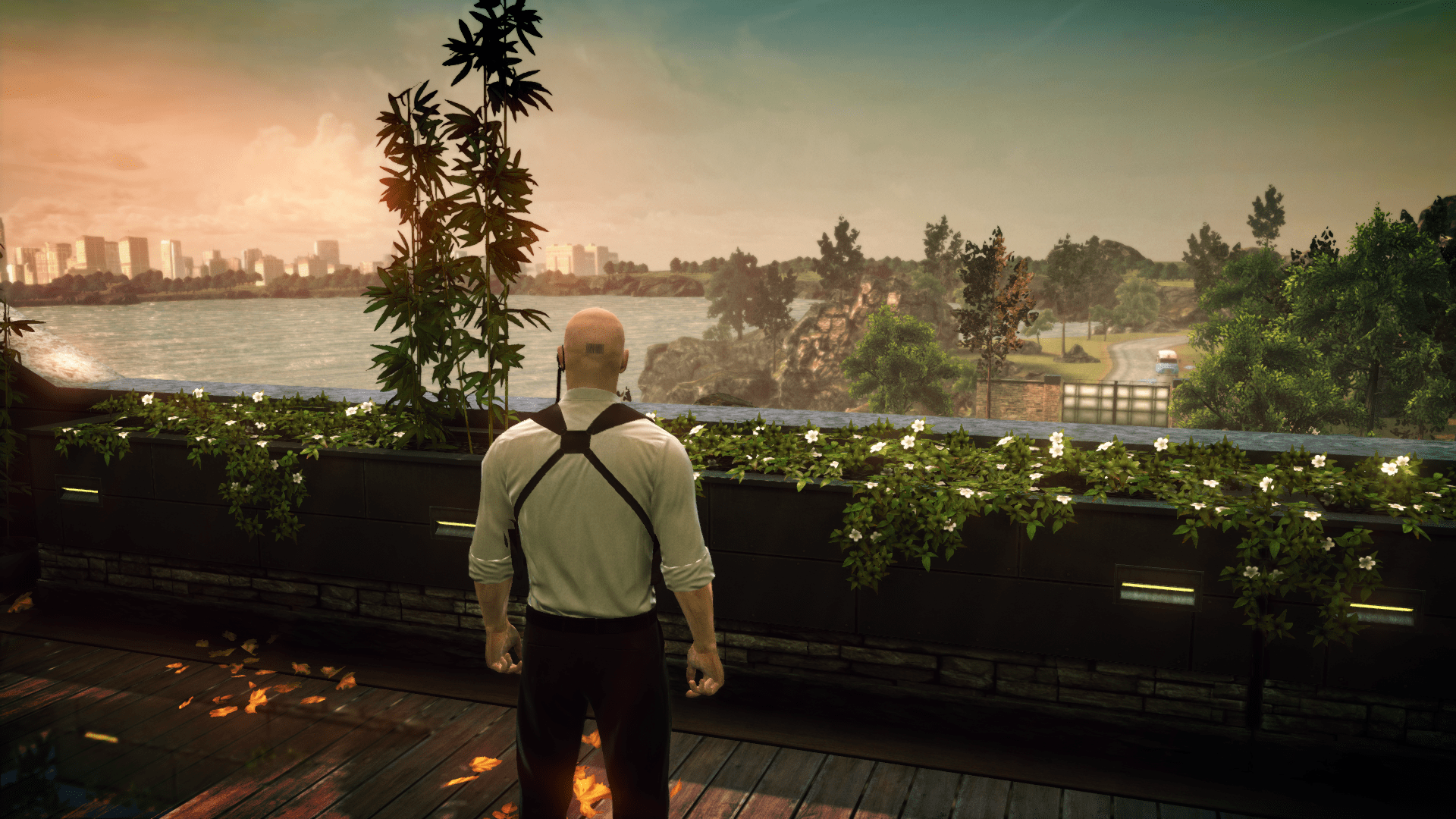
The main weapon in 47’s arsenal is his Instinct, which (at least on the normal difficulty) takes the form of a sort of X-ray vision that highlights NPCs, assassination targets, and interactable objects in the environment. It can also be used for point shooting, an all-out maneuver that allows you to target multiple enemies in line of sight and have 47 execute them all in a stylish scripted scene. It’s good in a pinch, but I much preferred the stealthier approach during my time with the game, and it’s here where the X-ray vision really comes into play. Being able to easily monitor nearby NPC movements through walls was a godsend, as it allowed me to plan out methods of moving through the level undetected, as well as see if a character was on track to discovering my hiding place. It’s also a huge help for missions with dedicated assassination targets; figuring out a target’s routine and crafting the perfect kill has long been a mainstay of the franchise, and Absolution gives the tools to let even newcomers do so.
You may have noticed the implication there: not every mission has an assassination target. These are by far the least interesting sections of the game. While they have the same solid gameplay mechanisms as the rest of Absolution, when the climactic moment is simply walking through a door as opposed to executing a perfectly-timed (or in some cases hastily cobbled-together) kill, there’s something sort of deflating about them. The game tries to add some more diversity with optional challenges for each section of a mission; these include finding all the different types of items and disguises, as well as more level-specific challenges like combining interactable objects in different ways or taking a certain route to the exit. Again, though, these just become more interesting on the assassination missions, as many of them encourage you to explore the myriad of ways you can take out your target. Who needs the ol’ “sneak up behind and garrote them” style when you can poison their food, bury them in a landslide, or kick them off a tall building? I will give credit to the challenges for encouraging replayability, as it’s impossible to get them all on a single playthrough. It’s also great that your progress on each one is saved even if you reload from a checkpoint, so you don’t have to keep picking up the same brick over and over again on each retry just to say you did.

Restarting from a checkpoint does fully reset all NPCs to their state at the start of the level, though, and while I understand this from a logistics standpoint, it was kind of annoying from a playability perspective. I wasted a lot of time in Hitman: Absolution waiting in cover for the same NPCs to have the same conversations and walk the same paths over and over before ultimately being in the proper position to let me step out and attempt my (likely doomed) plan over again. At this point, I’d almost think I could recite the speech the concierge in Blackwater Park makes to the security guards, if it weren’t for the fact that I did my utmost to tune it out for my own sanity.
In general, I like the system in place for being detected: if you’re in an enemy’s line of sight, a yellow arrow pointing in their direction appears on the HUD and starts to gradually fill up; stay in their vision for too long, and you’ll be spotted. Sure, it might be unrealistic that 47 can roll between cover points and have the guard staring his way do nothing about it, but it gives a lot more freedom of movement in levels and can be abused to pull off some truly ridiculous plays.

There’s also three “security levels” for areas: “normal”, which leaves 47 free to walk around; “trespassing”, in which case enemies who spot him will give him a chance to walk away before turning hostile; or “hostile”, meaning enemies will immediately threaten him with weapons and attempt to take him down if he’s seen. The delineation is implemented well enough, but the problem is that most areas in the game are hostile throughout. This means that there’s little room to explore and experiment without rapidly being threatened by enemies, making it challenging to plan out your moves effectively. It does encourage players to think on their toes, but too often I found myself forced to restart from a checkpoint because all hell broke loose after a disastrous attempt at a part of the level I couldn’t possibly have planned for. In fact, on those disastrous attempts, I would often run through the level while under heavy fire, trying to mentally map out as much of the area as possible before dying; not exactly the calm, collected demeanour of a professional at work. This gets worse on the assassination missions, as even finding your target without the use of instinct can be a challenge, let alone crafting the perfect way to end their life. In the end, my favourite levels were ones like an early mission in Chinatown: while it has several restricted areas, the bulk of the level is a bustling market full of crowds to blend into and areas to explore, all while monitoring a target who starts clearly visible in the centre of the map.
Presentation-wise, Hitman: Absolution holds up alright. I think the lighting does a lot of work here; whether it’s the sun’s golden rays shining between gravestones or fireworks lighting up a busy Chinatown district, it consistently looks good. Texture quality is also pretty good, and some of the crowd sizes are rather impressive, especially for a game that came out on the Xbox 360 and PS3. However, I think the animations are where the game suffers the most, with characters regularly moving with a sort of jerkiness that looks uncanny. There’s also a mix of pre-rendered cutscenes and in-engine ones to tell the story, but the pre-rendered ones only look marginally better, still exhibiting the same animation issues of the in-game models. The voice acting and music are both fine, but forgettable, with only David Bateson reprising his role as the cool, calculating Agent 47 really sticking with me.

Hitman: Absolution is a weird game for me to assign a score to because of how much my experience varied with it. For the first half of the campaign, I found myself regularly getting annoyed by the more linear, less assassination-focused missions. It actually took me watching a YouTube video of someone playing the game on the hardest difficulty to realize the extent to which Absolution allows players to mess with its systems, and I subsequently started playing a lot faster and looser to great effect. By the end, I was seamlessly ducking between pieces of cover, abusing the hell out of the delayed reactions of enemies, and setting up elaborate Rube Goldbergian processes by which I’d complete each level. Walk up here, throw a knife onto the floor there, stroll through the hotel lobby unaccosted, mess with a computer, disguise myself as a concierge, and slip into the elevator undetected. I began pushing myself further and further with each mission: surely I can do this one without any disguises and no collateral damage and without being spotted by anyone? When I was about a quarter of the way through the campaign, I thought that I’d just play it through once and be done with it, and now I keep thinking about going back to chase down some achievements. Even a couple weird glitches where 47 going to garrote someone caused both characters to freeze and the NPC to T-pose elicited more good-humoured laughs than it did frustration at having to restart. Hell, I wish the Contracts mode was still online so I could mess around with some of the community-made custom contracts, though I have heard whispers of fan-made servers keeping it alive. Overall, I have to say that I enjoyed my time with Hitman: Absolution, and while I get the sense that it isn’t the best game in the franchise, I think it’s snuck its way into my heart and made me excited to see what the other games have to offer.
7/10
 Olive's Game Garden