Sometimes you play a game and can tell right away that it’s going to give you Thoughts™, but that wasn’t the case with Technotopia. My time with it started out the same as any other game, doing my best to get absorbed into the world it crafted and gameplay mechanisms it implemented, all the while taking notes on the side to prepare for the inevitable review. And then things changed. The narrative beats slowly began to go off the rails and I went from raising an eyebrow occasionally to having one permanently cocked. Futurist stories have the capacity to hold up a mirror to our current world or speculate on what tomorrow may bring, and yet Technotopia frequently feels like it gets so lost in critiquing what’s happening now that it forgets to provide that extra layer of futuristic abstraction. This is less satire, and more someone stating their beliefs directly to the player. And let me say, some of those beliefs are … questionable to say the least.
I’m getting ahead of myself, though. For the uninitiated, Technotopia is a roguelite deckbuilding city builder, which is to say that it plays out over multiple “runs”, each of which drops you into a randomly-generated city grid. You then play cards drawn from a deck to build structures in the city, and gradually your choices add more cards of certain types to the deck, allowing your playstyle to swing towards one or more strategies over time. During play, you’re trying to balance your resources for four different factions: Government, Elite, Business, and Public; if any of them drops to zero, it’s game over. Each has an upkeep cost that must be paid at the end of each ten-turn cycle, with the cost then increasing by a static amount at the start of the next round. The costs can also be influenced by events that happen halfway through each cycle, in which you get to make a choice that impacts your society in some way. Those choices also boost your influence with one of five factions (the base four, plus the Criminal faction), which is used to unlock more cards for your deck after each run. These events are where the bulk of Technotopia’s social commentary takes place, and also where the bulk of the problems emerge.

Generally speaking, Technotopia takes a pretty bleak approach to its events, at least if you go for the choices that seem immediately beneficial. It’s a twisted form of entropy where everything eventually breaks or falls to corruption, and there’s really nothing to be done about it. For example, the Public answer to high unemployment is to create more jobs … and then the new factory that’s constructed becomes a money-laundering tool for criminals – well, more so than a normal factory under capitalism. Installing more street lights as a response to people feeling unsafe at night seems like a better choice than security cameras or more cops … until crooks just break the lights and you’re back to square one. Not only do these outcomes strain the limits of my credulity (so nobody thought to keep an eye on the finances of the factory after it was built?) but they take a profoundly negative outlook on what people will do when left to their own devices. Call me naive, but I think people have better things to do at night than clamber up newly-constructed street lights to break them.
Then there’s Technotopia’s views on the police: namely an admiration for them. In-game, I tried responding to a mob-organized protection racket with more police, and at first was surprised when Technotopia said it led to ordinary citizens getting arrested as the cops became overzealous. However, my hopes that the game would acknowledge the often corrupt practices of law enforcement were just as quickly dashed when it followed that up by saying that crime went down and riots ceased. Granted, to the game’s credit, providing social programs for young people also led to a decrease in crime with this event. However, more police funding was consistently acknowledged with a decrease in crime in other events as well, which made it hard to ignore which direction Technotopia seemed to be leaning. What it fails to recognize is that this doesn’t hold true in the real world; there isn’t a consistent inverse correlation between police funding and crime statistics.

Similar notions have been bandied about in recent times as a response to the “defund the police” movement, with people claiming that the police were defunded horribly in the wake of the 2020 Black Lives Matter protests and crime skyrocketed as a result. This simply isn’t true, though; the police were never defunded, and in fact often saw their funding increase post-2020. And don’t even get me started on how historically discriminatory and excessively violent cops are. The closest Technotopia came to acknowledging this in my time with it was when I was given the option to respond to a bank heist with a police show of force; all that came of that was the public mourning the lives that were lost during the engagement, but at no point was the “rightness” of the decision interrogated.
On the other side, Technotopia seems to show a general disdain for the poor and working class, despite the Public being one of the factions you’re allegedly trying to appease during the game. For starters, in addition to the four main types of buildings that can be placed, each of which corresponds to one of the factions, there’s the Lower City tiles, representing the poor districts that exist below ground level in Technotopia’s sci-fi art deco metropolis. And boy, does the game consistently throw them under the bus. For one thing, they literally act as a drain on your resources, subtracting ten from every stockpile you have when you’re forced to place one out on the map. Sure, they can be combined into districts to, say, build a point-generating monorail on top, but that’s just it: the district gets built on top of the Lower City, rather than actually improving the underlying tiles. It feels more like gentrification than anything else, attempting to “improve” the Lower City by wallpapering over it with shiny new superstructures.

You can also rest assured that any time something sketchy goes on during an event, it’s happening in the Lower City. Plus, with each of the four main factions being associated with their own type of “productive” building (skyscrapers for Elite, factories for Public, etc.), it seems only logical to assume that the game is associating the Criminal faction with the Lower City, especially since gaining Criminal influence frequently puts more Lower City cards into your deck. Despite being the place where one has to assume the bulk of the city lives, based on what Technotopia has to say about it, you’d be forgiven for thinking it was nothing more than a crime-ridden, good-for-nothing slum filled with the worst of the worst. And this is only reinforced by some other comments made by the game.
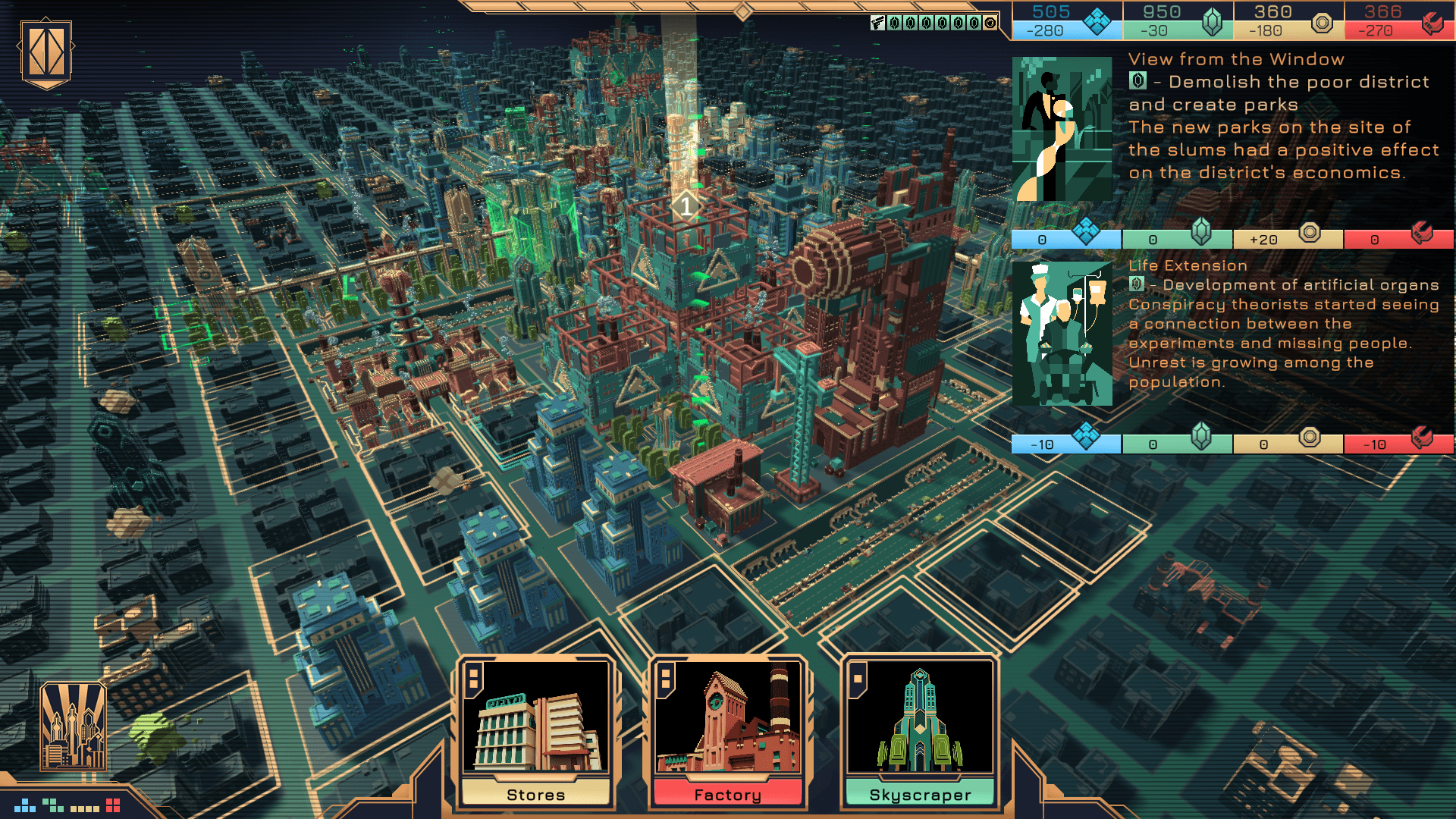
In one run, my response to an event around building more parks was to demolish the ghettos to make room for them, as I had started becoming morbidly curious to see how Technotopia would handle what I felt to be very questionable decisions. First of all, while this did lead to homes being demolished, the knock-on effect was that small-time crooks just left the city, which fundamentally misunderstands the type of people who turn to crime, particularly in this capacity. It should go without saying that the people holding up a convenience store or mugging an old lady are not wealthy enough to up and move to another city as soon as their home is demolished; instead they’ll just become homeless, which puts additional strains on basically every aspect of one’s life. Hell, they’d be liable to set up an encampment in the very park that their home was demolished for, and I really couldn’t blame them for that.
Eventually, once the ghettos were “emptied” and the parks constructed, the event’s follow-up effects culminated in a quote that made bile rise in my throat: “Finally, there are places where decent citizens can take a walk.” (Emphasis added by me). Good to know that the hundreds, if not thousands of people who were displaced and possibly made homeless aren’t even considered decent citizens. And while some might think that a higher rate of homelessness would lead to more crime, the research actually disputes this. More homelessness doesn’t lead to higher crime rates, however those who are homeless are far more likely to be the victims of crime, particularly violent ones. So in the context of this one event, countless people lost their homes and had their likelihood of being assaulted or murdered drastically increased, and Technotopia swept it all under the rug because “the good ones” had a nice place to wander around.
One feature of Technotopia I haven’t discussed yet is that of influence-based events. Basically, as you accumulate influence with a particular faction, that can change which events come up. Thus, as I desperately hoped to see better outcomes from repeatedly supporting the Public, I ended up getting more events seemingly tailored around their influence. Specifically, the one I want to discuss centred around the formation of an enclave that demanded independence from the rest of the city. Immediately, I was put in mind of the encampments and mutual aid networks set up around the recent Free Palestine protests; while I don’t think any of them attempted to declare independence, they did sort of act as their own miniature societies, often with controlled access and a focus on community rallying around a common cause. Of course my interest in seeing how Technotopia addressed such an issue was piqued, so I once again sided with the Public and allowed the enclave to declare its independence.
Things started off alright, with the enclave ceasing the use of money and giving everything people needed away for free. I was optimistic: could Technotopia really be allowing me to construct a mutual aid network? However, this was tempered once again by the game’s use of language, claiming that this led to “freebie hunters rushing into the new state”, which felt only a stone’s throw away from calling such people welfare queens. Life is expensive, and taking such a judgemental attitude towards people just trying to save a few bucks left a bad taste in my mouth. Unfortunately, this was only the beginning.
The next step was that all prohibitions and restrictions were removed, which according to Technotopia meant that drugs and weapons were available to children. This just feels like the game buying into baseless accusations of “lawless behaviour” happening pretty much anytime there isn’t a prevalence of government oversight. We saw it with the Black Lives Matter protests, where primarily right-wing outlets reported overwhelmingly on break-ins, looting, and other property damage as a way to discredit the cause. We see it now when reports of homeless encampments being cleared are headlined with words like “drugs and weapons seized”, fostering fear about these areas where, for the most part, people are just trying to live. And eventually in Technotopia, this area is simply cordoned off, becoming “the criminal heart of the city” and treated as one giant prison. Once again, this idea that without social constructs like money and the police, society will inherently fall into lawlessness is at best capitalist propaganda, and at worst deliberately undermining the goals of organizations that only seek to divest from or remedy the discrimination and hardship we see in our world.
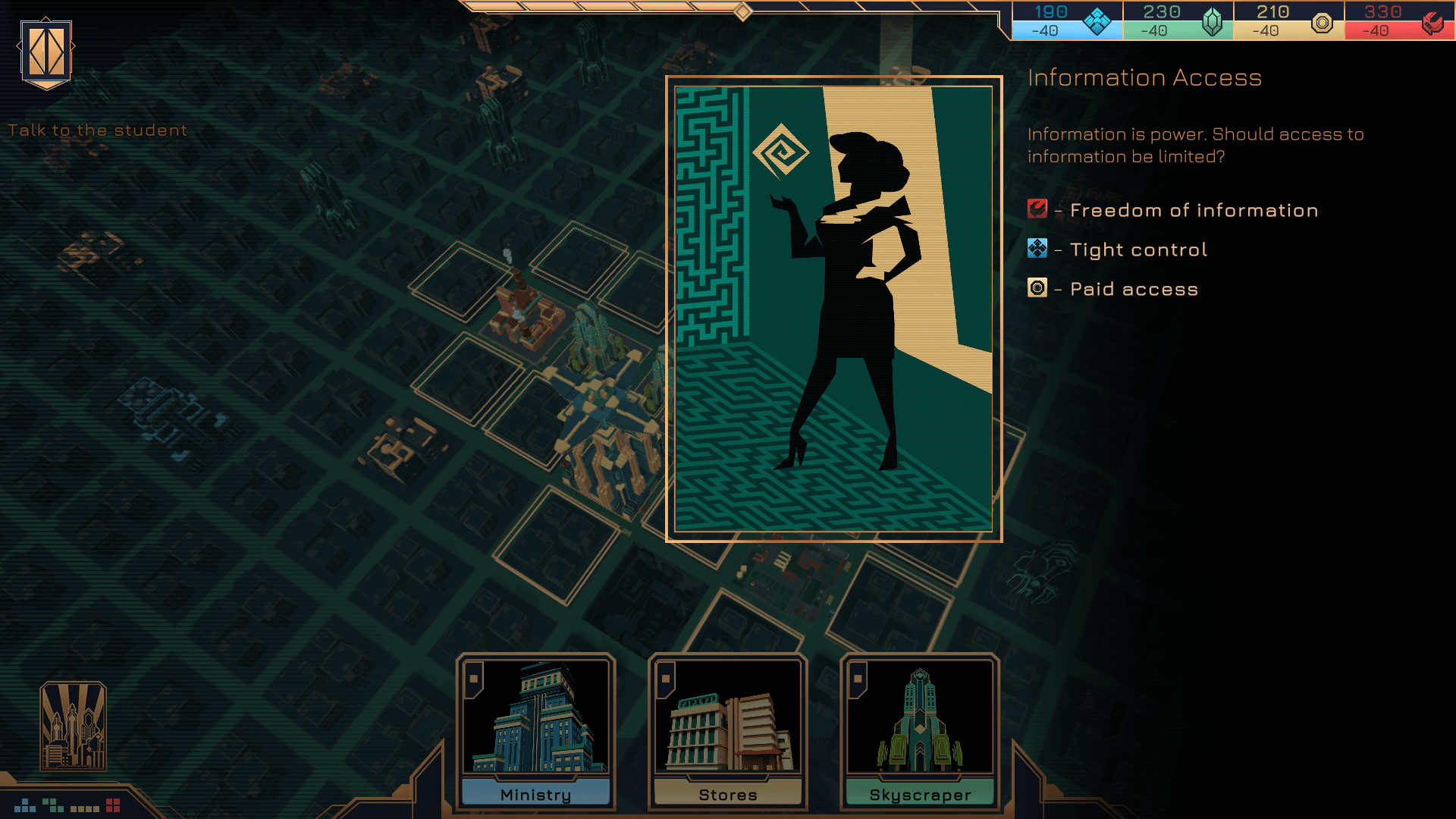
This bias also seems to be present in the way Technotopia depicts its factions. To be clear, all of them are corrupt in their own way; for example, the leader of the Elite wants to divert public funds towards building a theatre where she can perform, as well as silence critics who don’t care for her work. As an aside, your input on this doesn’t actually make a tangible difference; while the game does let you choose how exactly you want to deal with the critics, deleting their reviews versus, well, deleting them is simply a matter of choosing the option that best suits your resources at the time.
The issues with the other factions’ plotlines pale in comparison to the Public’s though. It centres around a terrorist cell that’s causing havoc in the city, which the leader of the Public wants dealt with. Well, I say it centres around a terrorist cell, but realistically it centres on the police and their investigation into the cell, to the point where I was wondering if I accidentally triggered the Government storyline by mistake. In fact, the leader of the Public becomes the villain when it turns out she’s been in league with the terrorist cell the whole time and murders a member of the police force in cold blood to protect that secret. Finally, after blackmailing her and getting her caught, it’s decided that a monument to the Public should be constructed … as a memorial to the police officer who died. This all comes from the same faction that – throughout the game’s events – has stood for things like supporting unions, rooting out corruption, and standing up for “the little guy”. To put it another way, the Public faction in Technotopia is essentially the game’s left-wing faction, standing diametrically opposed to the often authoritarian Government, bourgeois Elite, and capitalist Business. Yet the game frames them as a terrorist-supporting, cop-killing existential threat to society, and if that doesn’t feel like something ripped straight from a Fox News headline, I don’t know what does.
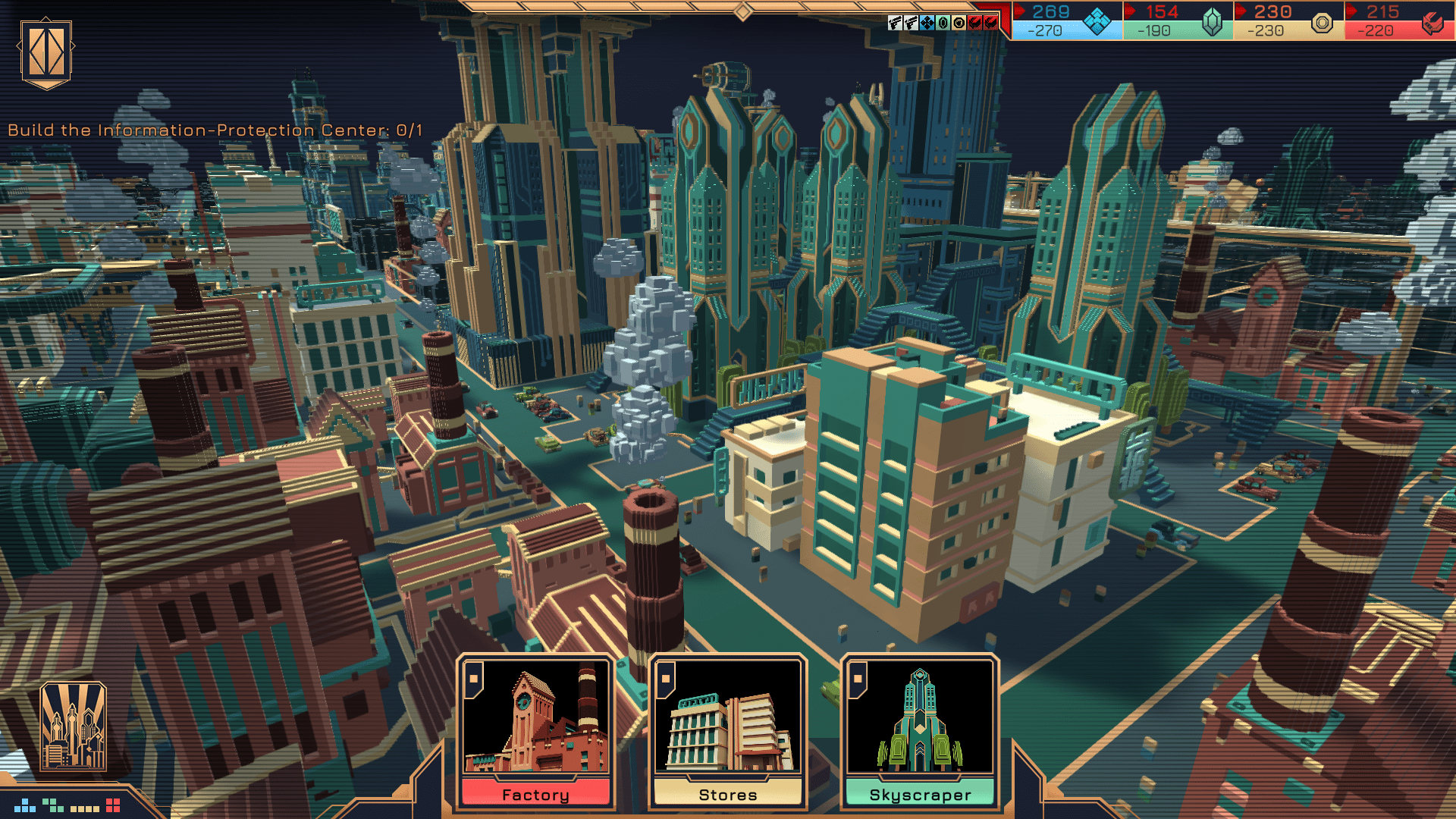
And lastly there’s the AI in the room. I’ve avoided discussing it up until now, but the player character in Technotopia is actually an artificial intelligence named Iris, who was created by a man known as the Architect for the purpose of designing the perfect city. Of course, such a thing is never truly possible (at least in the context of the game), as you learn over countless failed attempts. That doesn’t stop the Architect (and Iris by extension) from deciding that what’s really causing the problem is these pesky humans getting in the way. Thus, each story path culminates in Iris and the Architect manipulating the leader of one of the four factions into letting them capture that faction’s “heart”: a megastructure that represents all the power and influence that faction holds. The idea is that – once Iris controls each of the hearts – nobody will be able to deactivate her, and she’ll have true freedom to design the perfect city. And here’s the thing: it actually works! Completing the game’s relatively brief story mode requires capturing all four hearts in one go, and then a short scene plays out showing how everything is so much better now that Iris has complete control of the city.
To put it simply: no, just no. I’m “lucky” enough to live in an era where tech bros are salivating at every chance to replace human workers with artificial intelligence, from factory workers to writers. Of course, there’s conveniently never any plans around what will happen to those that are put out of a job, aside from some nebulous, “Oh, well they’ll find something else to do.” People are losing their livelihoods all because it’s financially cheaper (don’t get me started on the environmental implications of AI) for big corporations to slot a mediocre facsimile in their place and call it a day. The idea that society would be better if we just handed the reins over to a computer program is an absolute crock. Have you seen the slop being shoveled out by AI image generators? The only people who are embracing it are those with a financial stake in it succeeding, and to say they’re biased is an understatement and a half. Speaking of bias, let’s not even get into the fact that AI is inherently biased based not only on the data used to train it, but also on the biases of its creator(s).
Plus, at a certain point, there’s only so much that modelling and simulation can do; eventually the ideas of the AI would have to be implemented to see if they worked, at which point the lives of innocent people would be put in jeopardy all in the name of training data. To get personal for a second, I live somewhere where currently I’m being told that my rights are considered “less than”. Things like my ability to participate in sports and use a public restroom are being fricking legislated, and the only thing that could make that worse is if I was told that these decisions were being made not by fellow humans who could theoretically be influenced (or who one day will simply cease to exist), but by an omnipotent AI that had decided my rights were just not a good fit for the society it wanted to construct. Forward-looking media used to make me daydream about a future where artificial intelligence would solve all the mundanities of life and lead us into a brighter tomorrow. Now it just makes me sick.

And so it went with Technotopia. What seemed like it would be a fun way to pass the time turned into potentially the largest writing exercise I’ve undertaken since university. It’s certainly been an eternity since I’ve found myself looking up sources for something I’ve written, but I’m glad to get it out there. Removing the political context from Technotopia, it’s actually a game I was getting some enjoyment out of; it was a neat twist on an established genre, and while I had my qualms, it was still shaping up to be one of the better games I played this year. Unfortunately, I simply can’t ignore the missteps it takes in its messaging. If games are to be treated as art, they should be evaluated as such, and as an art piece making a political statement, Technotopia is thoroughly misguided.
 Olive's Game Garden