Developer: Acid Nerve
Publisher: Devolver Digital
Played on: PC
Release Date: July 20, 2021
Played with: Dualshock 4
Paid: $6.13
What is a Souls-like? I found myself asking that question a lot while playing through Death’s Door, as in some respects it clearly apes FromSoftware’s venerable franchise, while in others it distances itself. With the rabid fanbase those games have accrued (not to mention all the memes about “X is the Dark Souls of Y”), I’m always a bit wary when slinging the Souls-like label around, lest I be called a filthy casual who doesn’t understand the genre … or worse. In the case of Death’s Door, though, I feel relatively safe assigning the moniker, as even the Steam store page has it tagged as such; the fans have spoken, and all that jazz. I think that it’s also one of the more accessible Souls-likes I’ve played, though that’s not to say it’s easy. Rest assured that Death’s Door is more than willing to provide a stiff challenge, but – well – we’ll get into that.
If there’s one thing Death’s Door has going for it over Dark Souls, it’s that it’s visually a lot more charming. Trading in fallen knights and eldritch beings for little crows and cheery forest sprites is a move that instantly differentiates the game from its dour cohorts. The presence of music throughout also helps with this; despite being melancholy on the face of it, a lot of the melodies carry an undercurrent of mystery and hopefulness that made me want to get out and explore the world. That’s not to say the game is cute per se; it still has a washed-out colour palette, a narrative about the cycles of death, and generally the same (as it’s been described elsewhere) “beautifully bleak” atmosphere of its contemporaries. It’s just taken a genre where you so often have to fight to see the glimmers of hope in the world and brought them a bit further to the surface.
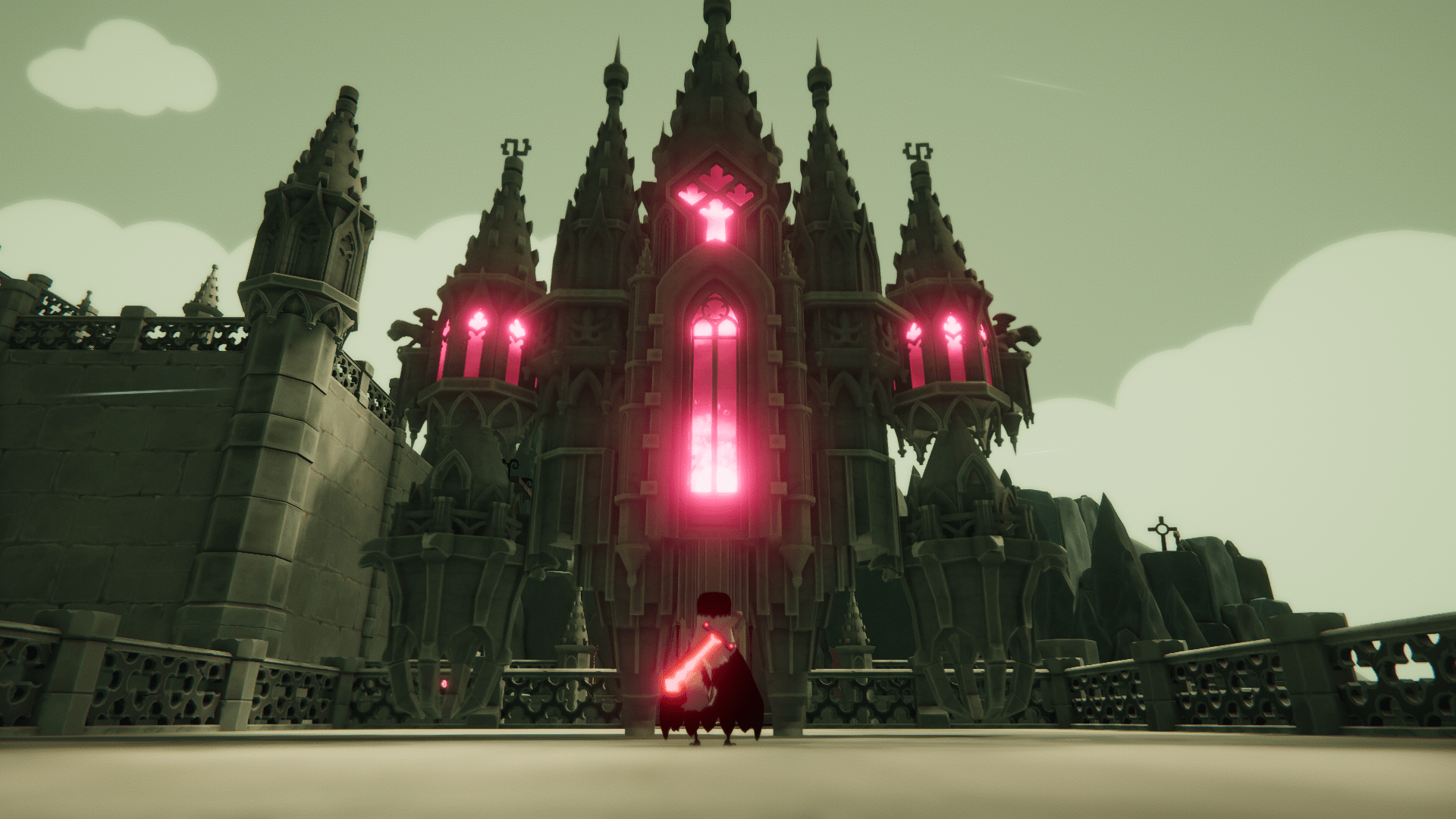
The general premise stays fairly gloomy, though. It revolves around you, as a fledgling reaper, being tasked by a much older reaper to obtain three Giant Souls from bosses scattered around the world. These souls will then be used to open the titular Death’s Door, where both of your assigned souls have escaped. See, crows such as yourselves that are employed by Death are functionally immortal, so long as they complete their reaping assignments. However, so long as the door to your target remains open and their soul unreaped, the spell is broken and you age as normal. The crow that assigns you this task had this happen long ago, and as he’s since aged out of being able to fight the holders of the Giant Souls, he actually steals the soul you were assigned, and – when it fails to be enough to open Death’s Door on its own – reveals to you that you’re now doomed to age like him unless you complete his task.
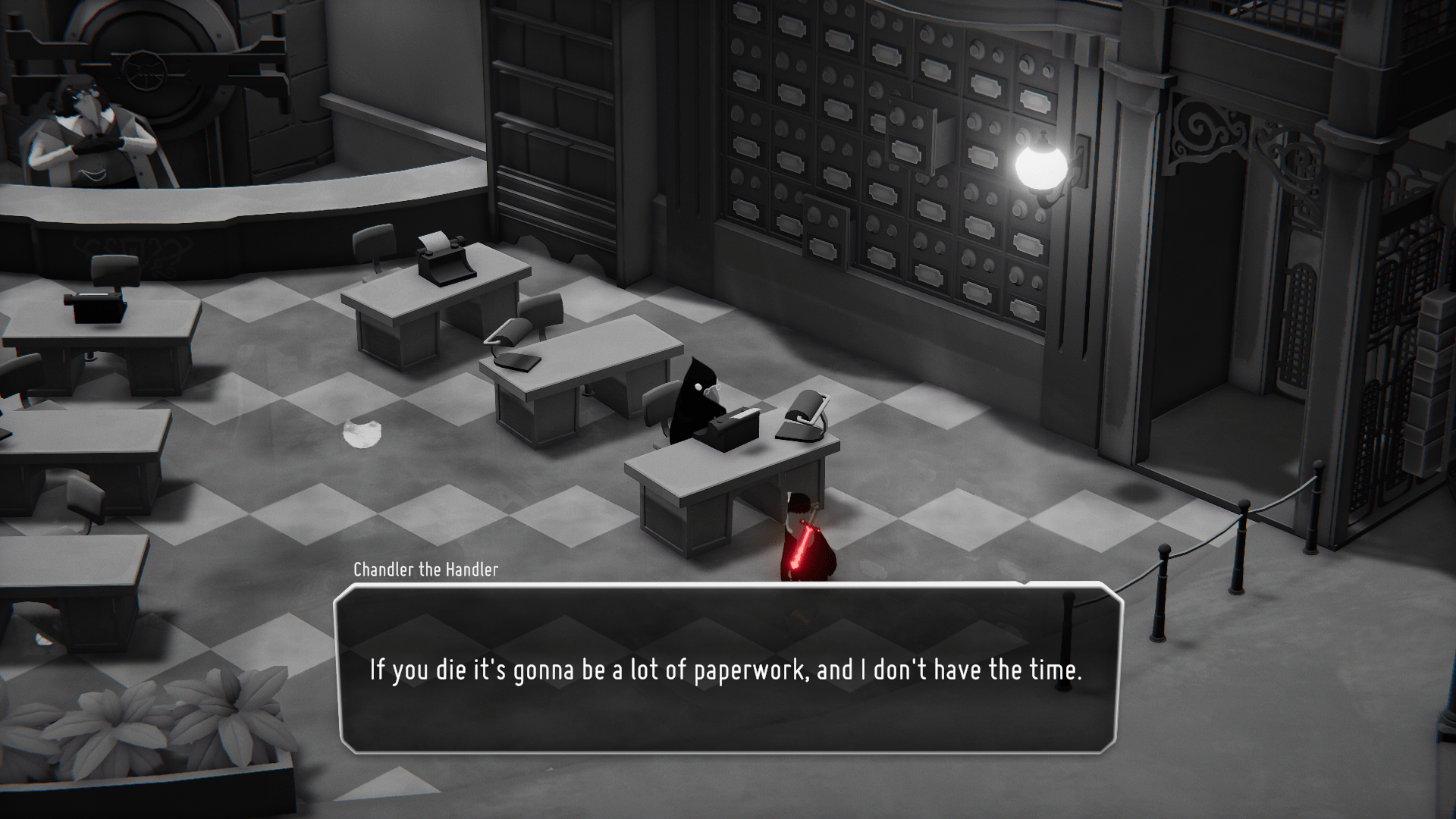
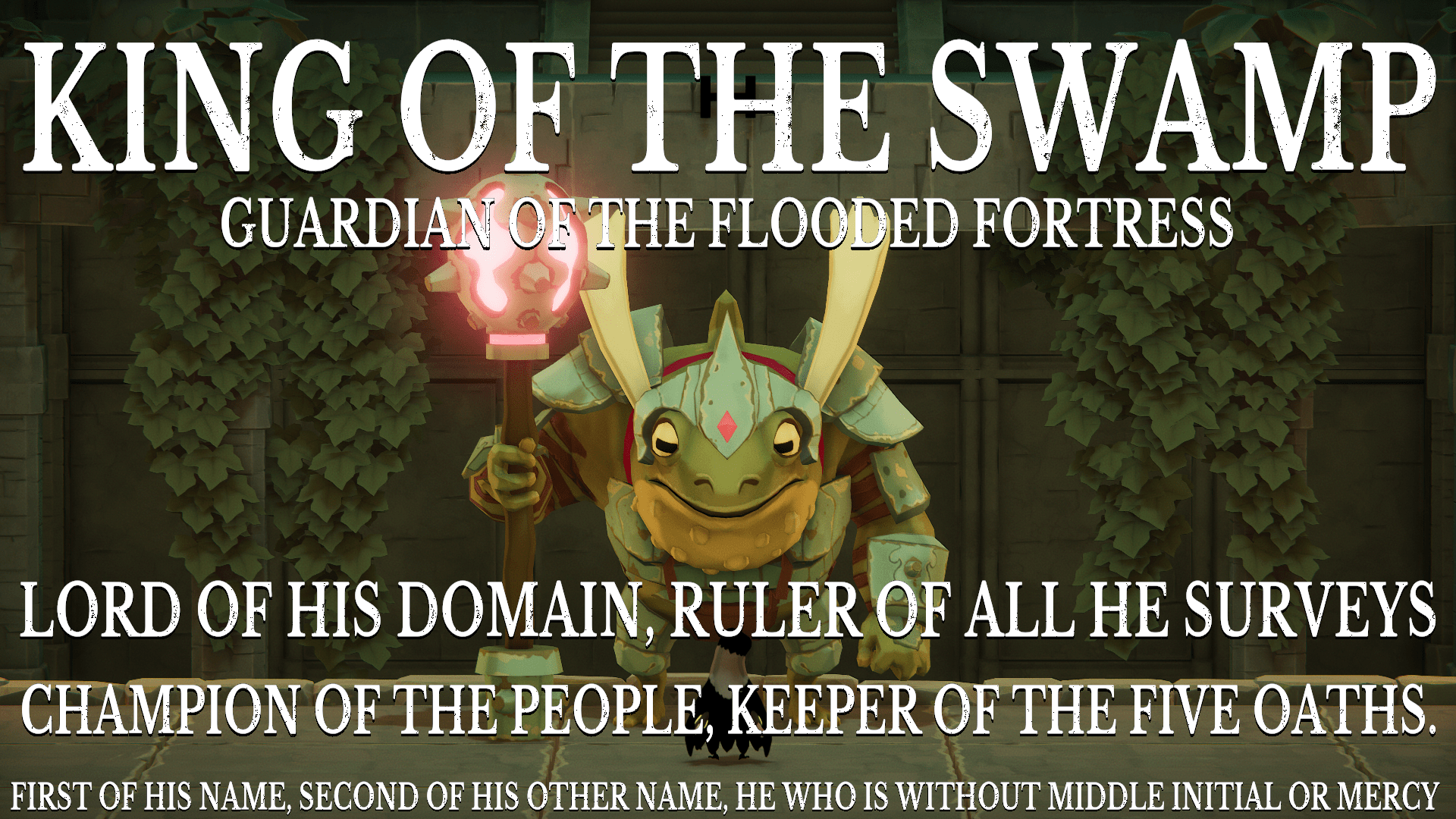
However, throughout this sombre core plot are splashes of humour and wit that keep things from getting too moody. Two characters in the hub area provide a nice dichotomy, with one complaining about how much paperwork your exploits will generate while the other rejoices in it. Minions tremble at the thought of being sat on by their mighty king, and a wicked witch gets increasingly irate with you as you wander through her manor, destroying all her well-kept pottery. The only time this levity didn’t really jive for me was in the funeral scenes. Upon reaping each Giant Soul, a funeral plays out for the fallen foe, complete with sorrowful music, a character giving a solemn eulogy … and random jokes thrown in that clash with the overall vibe.
The gameplay is where things get really interesting with the Souls comparisons. On the surface, Death’s Door seems to be a textbook Souls-like: hack and slash your way through enemies that respawn whenever you die, all until you get to a big boss that you hurl yourself against time and again until you finally overcome it. There’s a dodge roll, shortcuts to unlock, and limited healing opportunities. Look a bit deeper, though, and there’s a lot that Death’s Door does to make the genre more accessible. For starters, you don’t drop all your experience points when you die. This takes a lot of the pressure off of venturing into unexplored territories, as you can press on as far as you like, secure in the knowledge that – if you die along the way – you’ll be able to spend your points to level up before making another attempt. The aforementioned shortcuts are also arguably more plentiful, with the levels looping in on themselves with such frequency that death never felt particularly punishing; it was always a pretty short stroll to get back to where I was before. Checkpoints are more forgiving, with bosses almost always having one right outside their arena so you can get back to the fight quickly without having to worry about a lengthy run-up. The best way to describe it is that playing Death’s Door almost always felt smooth and fair, though there were some odd points of grit.
The most prominent issue is the difficulty curve. In a nutshell, it can be annoyingly spikey. Early enemies and bosses follow set patterns of behaviour; that is to say they’ll have one or more attacks that they cycle through on a consistent loop. This makes them challenging on the first few attempts as you’re learning their capabilities, but once you’ve got them pegged, it’s just a matter of getting into the right rhythm of dodges and attacks. I actually found that for the first half of the game, I was more likely to struggle with the game’s occasional enemy gauntlets involving multiple waves of foes in sequence, simply because of the sheer numbers advantage my opponents had. This all changed in the second half, as the bosses began to switch up their attacks more sporadically and also had fewer openings for me to deal damage. It marked a steep jump in difficulty, and venturing into the game’s forums showed other players with similar complaints about the less-than-smooth challenge curve.
Adding to this is the game’s healing system, which I’m really of two minds over. Scattered throughout the world are seeds that can be planted in special pots to grow life-restoring plants. These plants respawn every time you die or re-enter an area, so they end up acting as healing checkpoints throughout the map. On the one hand, it’s a clever system that rewards your exploration of the world with more healing opportunities. However, it really requires the placement of the pots to be on point, and I don’t think they always are. While they often appear right after challenging sections in the level, there’s also almost always one near each door in a level; the same doors that already act as checkpoints where you can fully heal, making the pots feel redundant. They also never appear in boss arenas, meaning you have no ability to heal mid-fight, further increasing the difficulty of those encounters. Finally, there’s the simple fact that – since they’re a location-based healing system – you may find yourself in a situation where you’re deliberately veering off course just so you can go heal … and possibly dying on the way there anyway. Say what you will about Dark Souls’ Estus Flask, but at least it’s always available to use whenever you want, assuming it has charges remaining.
The seed and pot system isn’t the only way Death’s Door incentivizes exploration, and I think its fixation on that element of gameplay will be what makes or breaks it for some people. For myself, I enjoyed poring over every inch of each map, activating switches, opening shortcuts, and finding secrets along the way. It helped that the levels all had distinctive designs (one standout took place in a large factory where platforms moved to the beat of the music) and generally stayed easy to navigate despite having various paths to go down. Discovering multiple hidden shrines enabled me to boost my health and special attack charges, and finding XP orbs gave a major boost to my ability to level up, unmatched by the generally paltry sums output by normal monsters. To that latter point, grinding for XP in Death’s Door doesn’t seem like a viable or fun strategy, which could easily put off players that like to use that as their answer to a challenging roadblock. Even then, the simplified skill system for levelling up feels pretty unremarkable; the only time I really noticed a change in my abilities was when levelling strength, and it was just the difference between defeating a basic enemy in three hits instead of four. The game attempts to remedy this with multiple melee weapons and special ranged options for you to swap between, but it’s only partially successful; once I found a build that worked with my playstyle, I never felt a reason to switch things up.

Furthering the game’s goal of encouraging exploration, the different ranged attacks also aid in world traversal, in a manner that gives Death’s Door a sort of Metroidvania flair. Returning to previous areas to unlock pathways with your new abilities is frequently rewarded, and I found out after beating the game that there were entire sidequests that I missed, even with how thoroughly I thought I was exploring everything. Thankfully, you can freely explore each area after completing the game, so it’s not like you have to start from scratch on a new file if you want to hunt around for missed collectibles. Overall, while I’m not the biggest fan of backtracking in games, I found that Death’s Door remained varied and interesting throughout its runtime and had me seriously contemplating a return trip to mop up everything I missed.
Combat in Death’s Door is fast and flashy, but unfortunately that can be to its detriment at times. Pro tip: go into the accessibility settings and turn off enemy flashes; doing so disables enemies flashing whenever you hit them, which makes it much easier to track if they’re planning a counterattack in your flurry of blows. When it comes to things that feel lacking, though, I wish the game had some sort of lock-on targeting for attacking enemies with basic attacks. I favoured the lengthy combos of the dagger weapon during my playthrough, and there were many times where – in the heat of all my slashing – I slashed right past my foe and started attacking the air instead. Additionally, there’s a melee charge attack that I got almost no use out of; it simply took too long to charge and dealt trivially more damage for the trouble. Lastly, while I like the game’s system of preventing ranged attack spamming (you only have a certain number of attack charges before you have to recharge by landing melee hits), the fact that there’s no targeting aid when using a controller makes it frequently frustrating to use them in the heat of battle. It was not uncommon for me to run out of charges simply trying to land a hit with a fireball, and I often decided it was easier to just hack and slash my way to victory.

Death’s Door tries a lot of things to put subtle twists on the Souls-like formula, and while not all of them are successful, I think enough are to let it stand on its own as a thoroughly enjoyable experience. The fact that there’s more to it hidden below the surface has me excited to return at some point, but even if it didn’t, I’d still be more than happy to recommend it. If you prefer your Souls-likes to be more on the boss rush side of things and don’t enjoy exploring the worlds they drop you in, that challenge may be amplified further; I could definitely see players feeling underprepared for the later challenges if they weren’t regularly finding seeds and XP orbs, though the perfunctory level-up system could actually alleviate that somewhat. Regardless, it’s a compelling adventure that feels like a good entry point to the Souls-like genre for those interested in getting their feet wet, while still offering enough challenge to stay engaging for veterans. This is one door you should really consider opening.
8.5/10
 Olive's Game Garden