Developer: Soft Not Weak, LLC
Publisher: Soft Not Weak, LLC
Played on: PC
Release Date: February 3, 2025
Played with: Xbox Core
Paid: $0 (Key Provided for Review)
Lofi vibes have been a centrepiece of my life recently. Whether it’s booting up Spirit City: Lofi Sessions while writing, throwing on a chill playlist on Tidal while working or playing games, or just curling up on the couch with my phone and a hot beverage, I’ve been all about getting into a cozy, meditative mindset whenever possible. Perhaps it’s stress-related; working full-time as a software engineer and dealing with the current political climate isn’t exactly a recipe for low blood pressure. Or maybe it’s a general desire to feel more centred and mindful for my own well-being. Whatever the case, having Spirit Swap: Lofi Beats to Match-3 To around to play these last few days has been a great asset, and it’s slotted itself right into my “good vibes” routine.
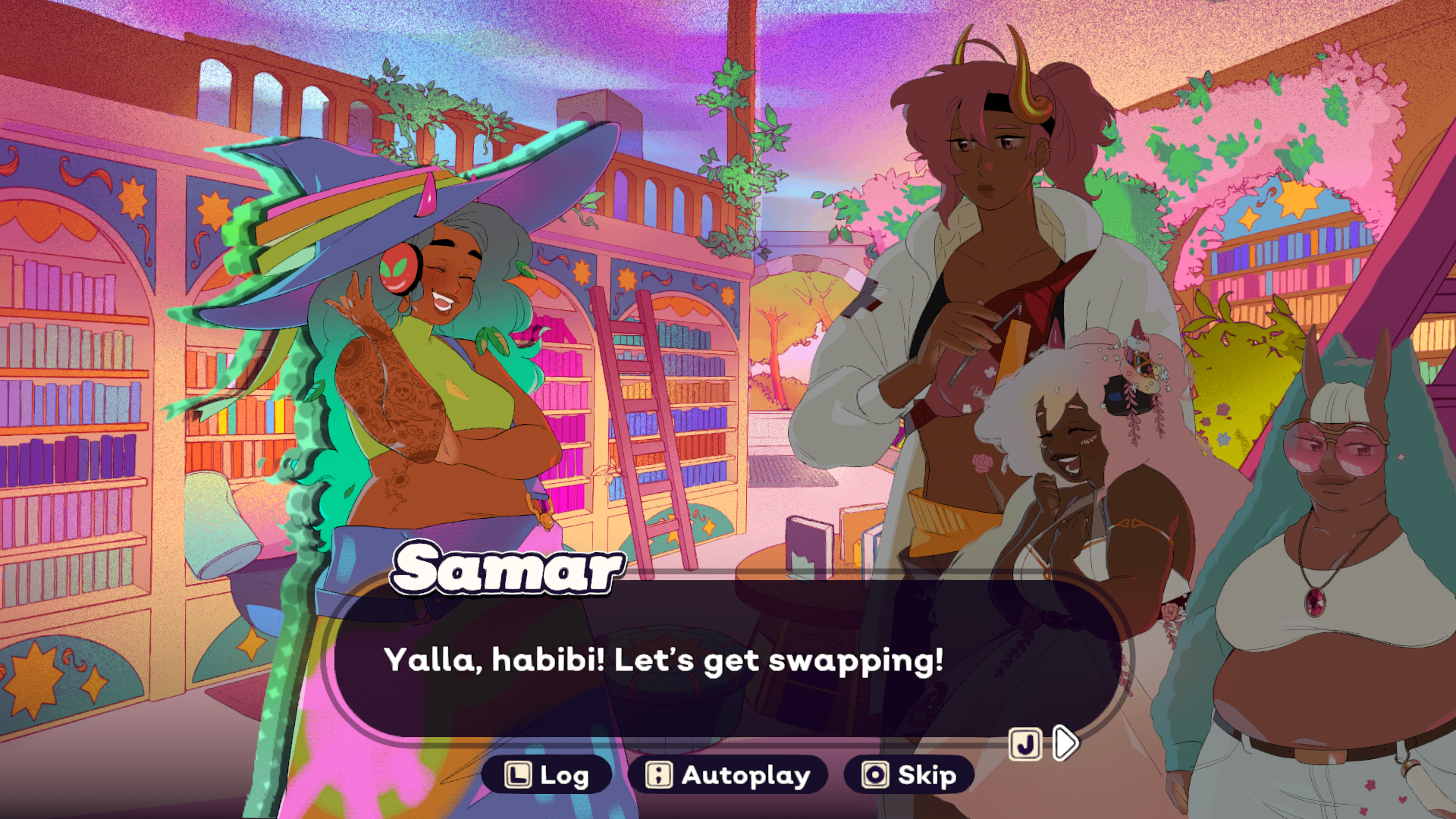
Stepping into the shoes of a young witch named Samar, Spirit Swap tasks you with ensuring that rogue spirits popping into your dimension find their way home safely. Samar usually works at night, wandering the woods on the outskirts of the town of Demashq to seek out wayward souls, but recently spirits have started showing up in droves inside the town during the day, causing all manner of mischief. It’s up to you to get to the bottom of the apparitions and sort everything out before a major concert tour arrives in town, all with the help of a diverse cast of characters.
I really want to emphasize the “diverse” part of that last sentence, because as Samar travels around town to meet up with her friends, we’re introduced to a veritable cornucopia of colourful characters. The cast is chock-full of people on the QTPOC (queer, trans, people of colour) spectrum, and I’m 100% here for it! Not only that, but there’s a great diversity of body types on display, to the point where I was actually able to see myself and some people I know in the characters; a delightful change of pace for a video game. And to be clear, Spirit Swap commits fully to making sure all these characters are beautiful in their own way; nobody gets singled out as being “the ugly one” or anything gross like that. Sure, everyone has their preferences, and there were certainly some characters that I scoped out more than others, but it really feels like a game with a little something (or someone) for everyone. I guess if I wanted to put it less diplomatically: Spirit Swap gave me a significant amount of pansexual panic, and I loved every second of it.

There’s also ample opportunity to interact with those characters, as Spirit Swap is a sort of hybrid visual novel/puzzle game with a splash of dating sims thrown in. Essentially, the gameplay boils down to going to different places around town to chat with your friends and advance the plot, with a spirit swapping puzzle battle in the middle. After completing the fairly short, linear main story, you can go to locations more freely to build up relationships with individual friends, and occasionally do more spirit swapping. To put it in perspective, each character’s “route” consists of around six encounters, and on average two of them also include spirit swapping. It means that the post-game (which is actually 85% of the game according to the completion percentage on my file after finishing the main story!) consists of a lot more talking than puzzle-solving, but I actually didn’t mind the shift in balance. Every character is fun and engaging in their own way (even the ones that drive me up the wall sometimes … looking at you, Iskandar, you damn thembo), so getting to know them more is a treat.
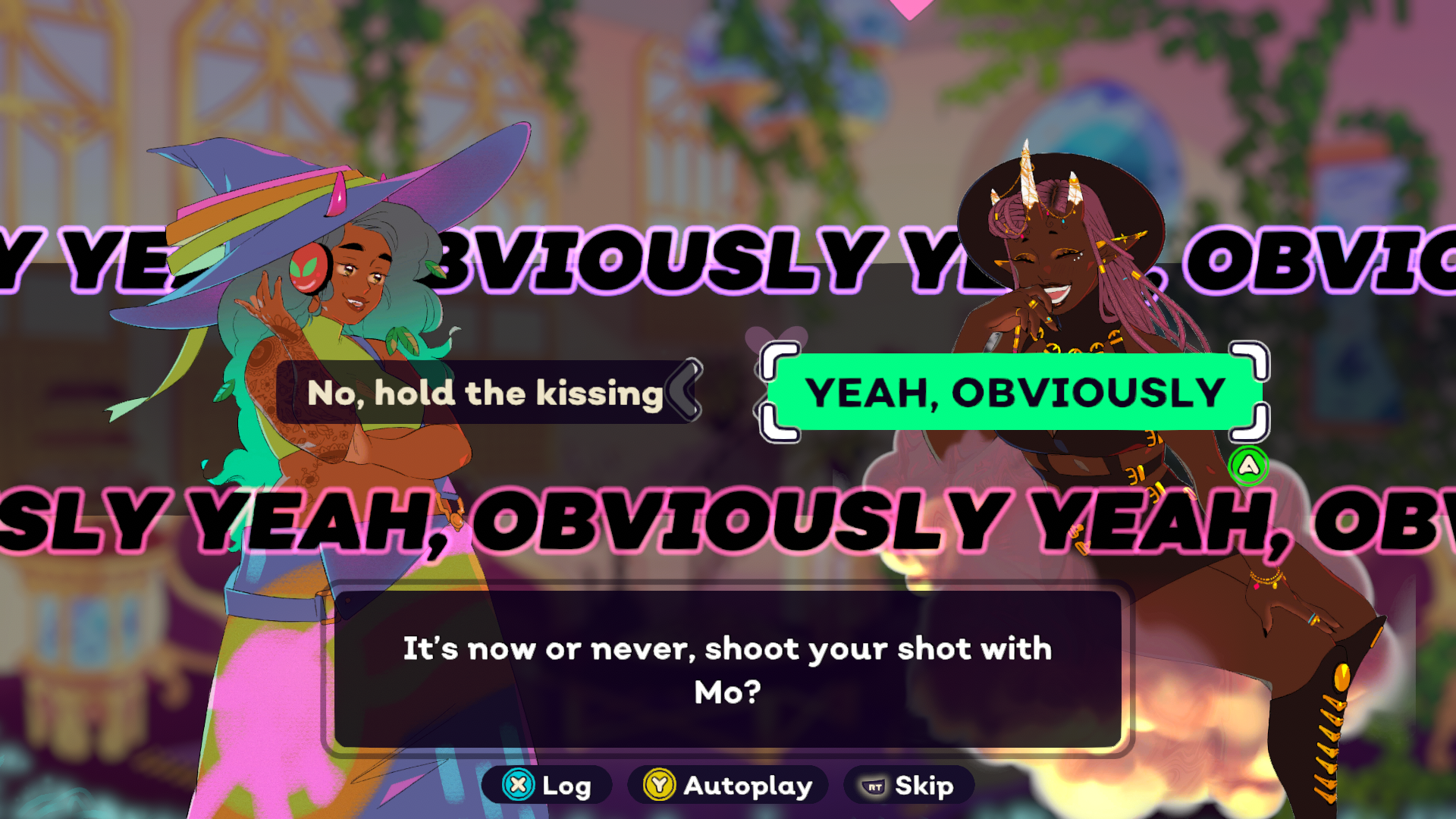
As each relationship builds, there comes an inflection point where you can choose to pursue a more romantic relationship (aka “Butterflies”) or just stay friends (aka “Homies”), and from what I saw, Spirit Swap handles this admirably. I went down the Butterflies route for two characters and Homies with one, and in all cases the relationship continued to grow past that decision point, just with a different (albeit always wholesome) outcome. I also really like that the characters feel grounded and realistic in their interactions. For example, asking someone out when they’re still getting over their ex results in an honest conversation about feelings and relationship expectations, rather than Samar being an instant rebound for their friend. There were a few minor inconsistencies in the plot, like one case where Samar witnessed a major event, but then later had no knowledge of it, but this was easily overlooked when the writing was otherwise so consistently well done.
So when you’re not chatting up all your Demashq besties, what are you doing? Well, spirit swapping, of course! I’ve mentioned it a few times now, but to get into the details, the titular mechanism takes heavy inspiration from games like Tetris Attack and Panel de Pon, presenting you with a grid of colourful spirits and tasking you to clear them as quickly as possible by swapping horizontally adjacent entities and making matches of three or more. As you do this, more spirits slowly rise up from the bottom of the screen (and you can actually expedite this process with the push of a button if you need more swapping options), threatening to overwhelm you if your screen ever completely fills up. To add an extra wrinkle, making matches fills up a spell meter which can be drained to cast powerful spells that help with clearing the board, however casting each spell requires making a specific formation of like-coloured spirits; either a square, diamond, or X.
Setting up for the spells can be challenging, and I often only used X spells when the shapes happened to appear naturally, as otherwise it took too much focus away from the simple act of clearing my board. However, the fact that you have access to one of each spell type during the story means it’s more likely you’ll be able to use at least one of them, and there’s some good variety on display, with new spells getting unlocked throughout the story as Samar encounters new characters. Between plot beats you can return to Samar’s room to change up your spell loadout, decorate with items gained from your interactions, and even have fun text chats with your friends on your computer, which has the double effect in the post-game of making them available to meet up with on the map if they aren’t currently showing up there.

While Spirit Swap does offer an endless mode for you to swap spirits solo and chase high scores, the crux of the game is its versus battles. During these, making combos and cascades causes Garbage Blocks to fall on your opponent’s board, with them constantly doing the same to you. The only way to clear these is by making a match that touches them, at which point they turn into spirits that can be matched just like any others. Suddenly, what was once a blissed-out, meditative exercise can turn remarkably hectic, as you struggle to fill your opponent’s screen before they do the same to you. The winner of each battle is whoever can win three rounds first, so there is thankfully a bit of wiggle room for mistakes if you’re not consistently on the ball. Plus in story mode the pause menu offers a “Win This Round” option if a particular fight is too hard or if you just want to get back to the narrative, which is a nice touch for story-focused gamers. There’s also three difficulty settings that change up the speed at which spirits rise on your board as well as the variety (up to six different types to work with on the hardest setting!), so there’s plenty of opportunity to tailor your experience. A sweet feature is that you can even set separate difficulties for each player when playing local PvP matches against friends, putting a bit of a handicap in place if one player is significantly better than the other. You can also give one player a character with a weaker (or harder to pull off) spell, which can also help to balance the scales a bit. That’s all to say that if you want a challenge, Spirit Swap is more than happy to offer one, but casual gamers definitely shouldn’t be scared off.
I enjoyed the versus battles a lot; the chilled-out beats combined with the at times frantic spirit swapping gameplay made for an engaging juxtaposition that left me feeling excited for each new encounter, even when I lost. That being said, eventually (after beginning story mode on the medium, or “Spicy” difficulty), I had to hang my head in shame at my mediocre swapping skills and switch to easy (aka “Chill”) mode if I had any hope of winning the duels. This happened on the third story mission where you take on a spirit swapping match against The Polycule; I was managing just fine up to that point, but perhaps the prodigious power of polyamory was simply too much for me to handle. Alternatively, maybe I just need to “git gud”, considering a series of versus battles against a friend who had never played (after I had beaten the main story and multiple character routes) saw me getting handily demolished each time.

The presentation in Spirit Swap is sublime overall. Everything from the relaxing music to the vibrant and beautiful art overwhelmed me with cozy vibes, to the point where I really wanted to curl up in bed with the game, my dog, and a hot drink. Things can amp up on the audio side in versus contests when one person’s getting close to winning, but it still put me in a focused mindset rather than being distracting. The voice acting is also great; despite a few characters having a noticeably different tinge to their recording (it sort of sounded like some people were recording remotely with different equipment), I still enjoyed what was on display. From the boisterous bravado of Iskandar to the frenetic and excitable Lulu, all the way to Mo’s smooth as butter delivery, the characters all feel distinct from one another and fleshed out. It says a lot that I was a bit disappointed when not all the dialogue exchanges outside of the main story featured full voice acting, though the strong writing does still work without it.
I will throw out that I encountered a few bugs and issues during my time with Spirit Swap, though nothing game-breaking. After chatting with someone on Samar’s computer, their bio always got replaced with Leon’s, which threw me off the first time it looked like Mo had changed pronouns over the span of a short text chat. Additionally, achievements seemed bugged, often not unlocking until long after the trigger for them had happened, or in one case, not at all. Lastly, a couple of the spells you can use while spirit swapping freeze some of your opponent’s spirits temporarily, making them unable to be moved until the spell wears off. You can still make matches with them, though, and this is made difficult by the fact that the frozen effect really obscures what type each spirit is; in the heat of the moment, I basically had to remember what each spirit was before they were frozen, which often meant I ignored them altogether.

None of that takes away substantially from how excellent Spirit Swap: Lofi Beats to Match-3 To is, though, from its delightfully diverse cast of characters to its engaging spirit swapping gameplay and everything in between. I was a touch worried going in that I’d feel out of my depth on the puzzle side, as games like Tetris have never really been my forte, but I was pleasantly surprised at how accessible the design really was. If that was all that was on offer, it would be a fun distraction, but adding in the extensive visual novel/dating sim side to things really takes it to another level, giving a whole host of unapologetically queer people to get to know and thirst over. And hell, if that’s not your bag, just be friends with everyone instead! The game really lets you choose how you want to approach its character encounters, and that flexibility is hugely appreciated. Spirit Swap is clearly a work of love and passion from everyone who helped put it together, and I hope to see more from this team in the future. Now if you’ll excuse me, there’s a bunch of characters I still want to try and smooch; wish me luck!
9/10
 Olive's Game Garden