Developer: Ao Norte
Publisher: Super Rare Originals
Played on: PC
Release Date: April 8, 2025
Played with: Mouse
Paid: $9.37 (Backed on Kickstarter)
I never got into the Polly Pocket craze as a kid, due in no small part to a fairly strict adherence to gender stereotypes. That being said, I don’t recall them ever entering our household, even in the hands of my older sister. There were several Barbies and similar toys, but Polly Pockets seem to have passed us by. However, even now I find the concept to be pretty fun: a portable capsule toy that contains a customizable world within, featuring furniture, toys, and of course, little dolls. It provides all the necessary features of a dollhouse, without the large space and financial commitment inherent in one, easing the burden on parents wanting to provide a way for their child to play house or other activities.
Take that premise and combine it with a puzzly garden sim, and you have Tiny Garden, a game which allows the player to grow a vast array of crops in a capsule toy, then use the crops to either buy more seeds or purchase decorations to make their toy unique. It has all the hallmarks of a cozy game: bright, saturated colours, a charming visual style, and simple (at least on the face of it) gameplay to keep you whiling away the hours. It’s also a game that – now that I’ve put a couple hours into it – I feel exactly zero desire to return to.
Where does it all go so wrong? Well, the big problem is in the whole “using crops to buy more seeds” thing. See, Tiny Garden handles its decorations and seeds in different ways, much to the detriment of the latter. With decorations, once you buy one, you can place it an unlimited number of times. If you want to tile the walls of your toy with pride flags (a noble endeavour indeed), all it takes is purchasing that decoration once to unlock the ability. On the other hand, seeds need to be purchased every time you want to obtain more. Certain types of seeds will give you two for the price of one, but those are the exceptions to the rule. Even that wouldn’t necessarily be a problem, except that all seeds “chain” up from the three basic types: turnips, carrots, and cacti.
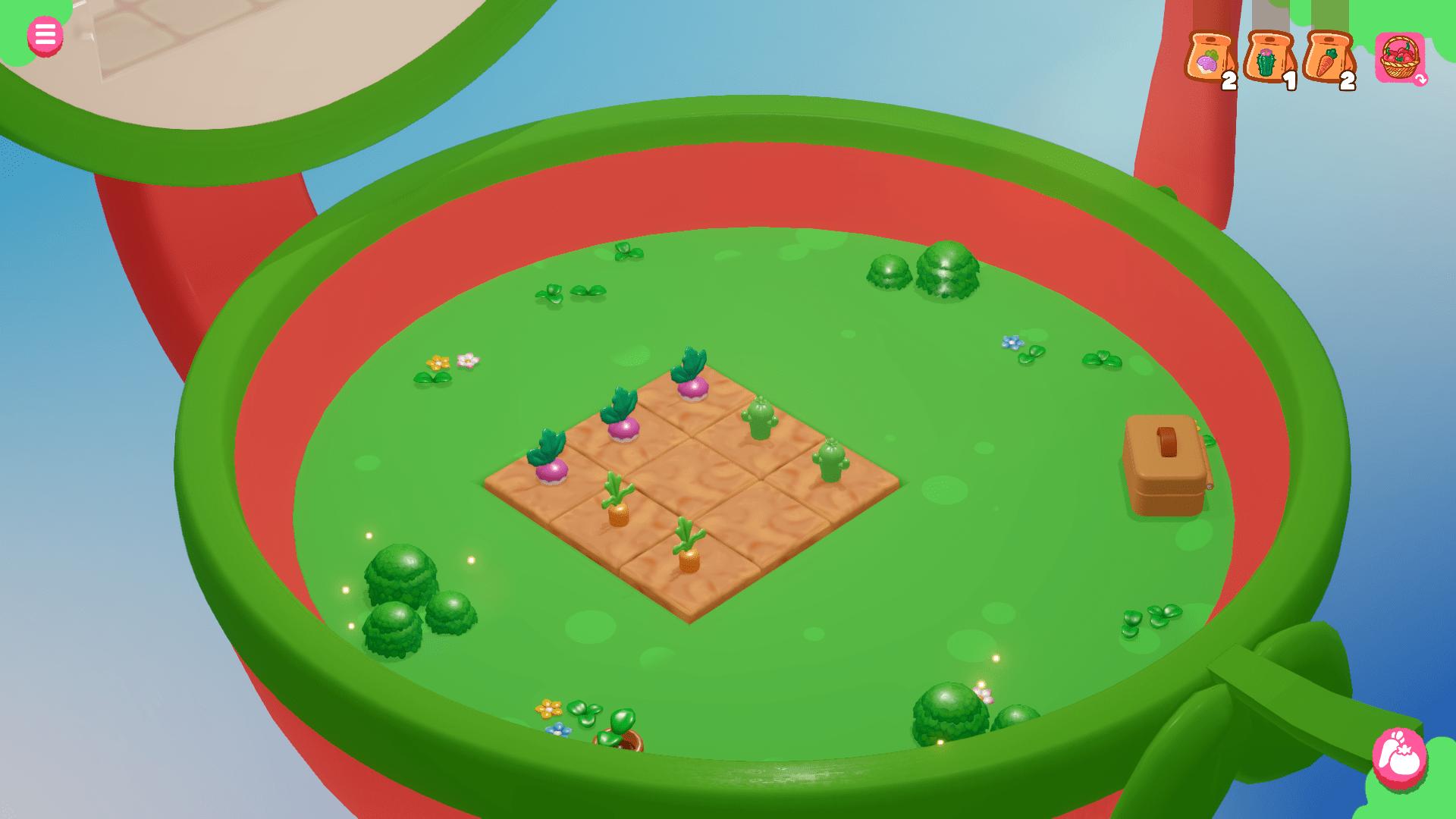
What this means in practice is that as you move up into higher-tier seeds, you start having to create increasingly large chains of different plant types in order to get where you want to go. For instance, I made it to a part of the game where I was trying to buy raspberry seeds. For a laid-back, cozy game like Tiny Garden, one would think this would be a relatively simple process. Instead, I almost had to break out a spreadsheet to map out the meticulous plan required to get a single raspberry seed. Raspberry seeds cost sweet potatoes, which cost lettuce and corn, which cost hydrangeas and lilypads, which cost turnips, carrots, and more lettuce, meaning that in order to buy the raspberries I so desperately wanted, I’d have to grow and harvest seven different “intermediate crops”. To be clear, that needs to happen every time you want another raspberry seed, which – considering the variety of plant seeds that have raspberries in their cost – is going to be a lot. It gets to be overwhelming and time-consuming, especially given the limited space you have available – it is a “tiny garden”, after all.
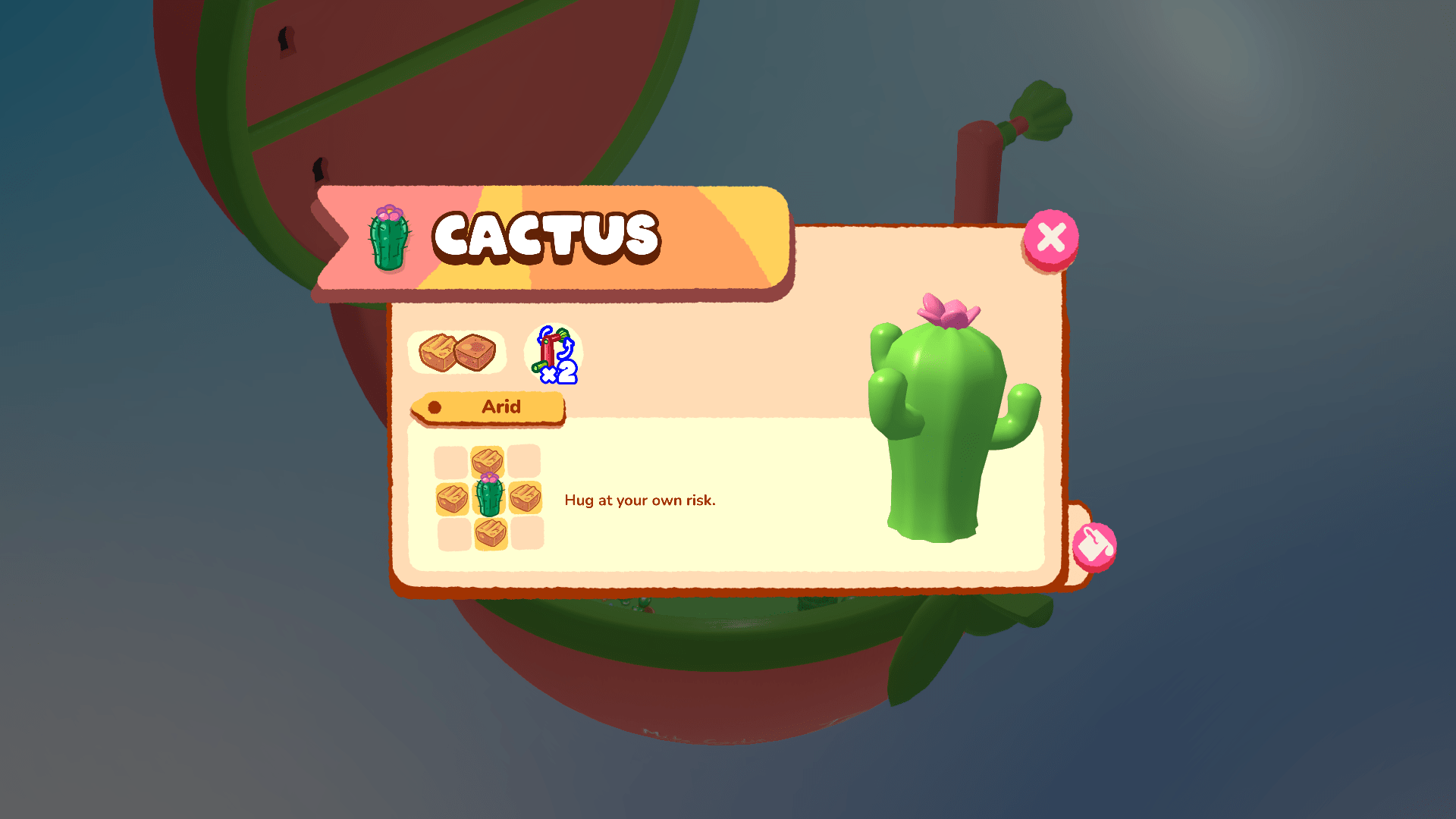
That’s not even getting into terrain requirements. Each seed can only grow in a specific soil type, and the way you get different ones is by adding specific plants and features to your garden. For instance, cactus plants turn all orthogonally adjacent spaces into desert terrain, but only as long as the cactus stays in the garden grid. Once harvested, those spaces will change back into normal soil after two turns, meaning if you have things that require desert terrain, you’re essentially forced to keep at least one cactus in your garden at all times, planting additional ones if you actually need to harvest them. This isn’t so bad with cacti, since they’re a basic seed that the game even periodically gives you for free. It gets more complicated with options like grassy terrain, though, which requires two hydrangea plants with a space in between that subsequently becomes grass-covered. It means that if you have crops that require grassy terrain, you need to regularly maintain two hydrangea plants on your board, taking up three spaces in your limited grid. Half the time, I found that Tiny Garden was just a battle of attempting to slot all the necessary terrain types onto my board in a stable manner, completely ignoring the actual growing and harvesting of crops.
This whole mess of buying seeds with different types of plants reminded me a lot of Rusty’s Retirement, which uses a similar system of requiring a certain number of plants of varying types to be harvested in order to unlock new ones. The key difference there is that those new plants are a one-and-done unlock, just like decorations are in Tiny Garden. And that’s for an idle game that’s meant to mostly run in the background! The tedium inherent in Tiny Garden’s design completely took me out of the experience; it’s simultaneously mindless busywork to grow all the plants needed to unlock the next seed type, while also requiring enough focus to not mess up terrain types or other requirements that it’s impossible to zone out while doing it.
I do have a few nice things to say about Tiny Garden. I love the presentation: everything has a plastic-y sheen that brings to mind the exact types of toys it’s intending to evoke. The soundtrack is inconsequential, but chill, and the tactile sensation of turning the crank on the side of the capsule to advance the turn is a really nice touch. There’s also a ton of content on offer, with over fifty types of seeds to unlock and countless decorations to collect, meaning if the game’s particular blend of gameplay works better for you, it’ll keep you busy for a while.

For me, though, I’m done with Tiny Garden. Playing games can be daunting for a number of reasons, but I don’t know if I’ve ever had one where I dreaded sitting down to play more solely because I knew I had better things to do. Games in general, but especially cozy ones, are meant to be an escape from the stresses of the real world, yet Tiny Garden’s cascading seed and terrain requirements perpetually made me feel like I needed to be optimizing my garden to the nth degree. It’s a shame, because I can see the seeds of a good game here, but it feels too at odds with itself to make me want to return.
4/10
 Olive's Game Garden