Developer: Pavel Auseitasau
Publisher: indie.io
Played on: PC
Release Date: June 2, 2025
Played with: Mouse & Keyboard
Paid: $12.81 (Backed on Kickstarter)
Pokémon games will always hold a special place in my heart. The first video game I owned was a copy of Pokémon Red that I played on a second-hand Game Boy Advance, and it was a truly transformative experience. Having so many different creatures to learn about and collect was exciting, and that combined with an expansive world full of mysteries and secrets made it something that I put countless hours into. Since then, while I’ve drifted in and out of the franchise, I’ve maintained an interest in seeing what it’s going to do next. In contrast, an area I haven’t explored much is the broader creature collector genre, which seems to be seeing a resurgence in recent years with games like Cassette Beasts and Beastieball becoming indie darlings. Enter Voidsayer, which combines classic creature collector trappings with some roguelite elements and a dark atmosphere to create a unique – albeit deeply flawed – twist on the genre.
In typical grimdark fantasy fashion, the world of Voidsayer has become blighted by a force known as the Abyss. This corruption has spread throughout the land, bringing caustic rains and mysterious diseases, and turning wildlife into beings known as Entities. These beasts have overrun the areas beyond the safety of your home, and are said to be immune to all weapons, making it a great challenge to deal with them. Luckily, some warriors are able to take control of Entities via sealing rituals, having them fight on the side of humanity instead of the Abyss. You are a new recruit just learning how to train and fight with Entities, and when some notes from a deceased soldier turn up with clues as to the origins of the Abyss, you’re tasked with setting out to learn more and hopefully find a way to dispel the corruption once and for all.
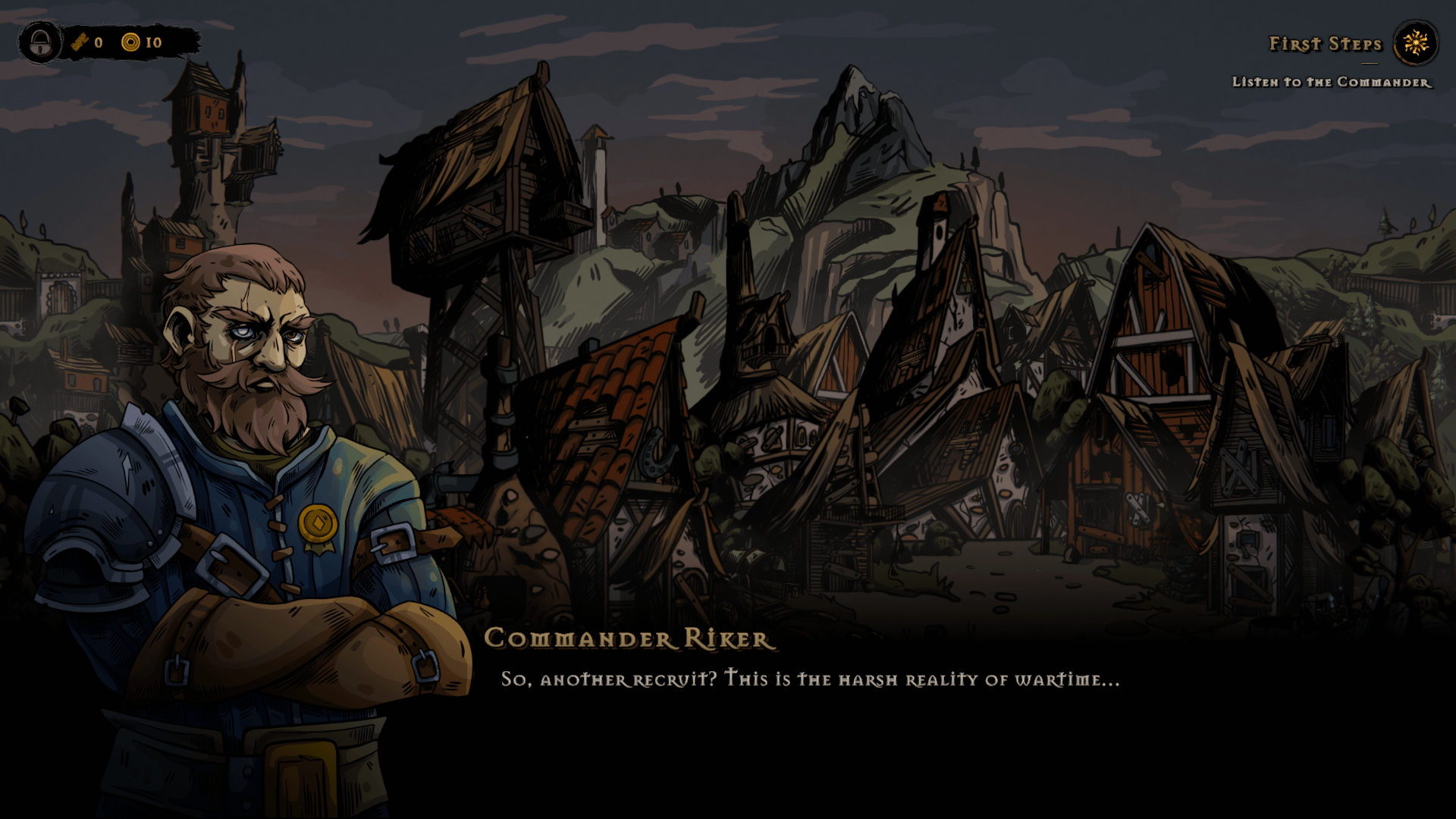
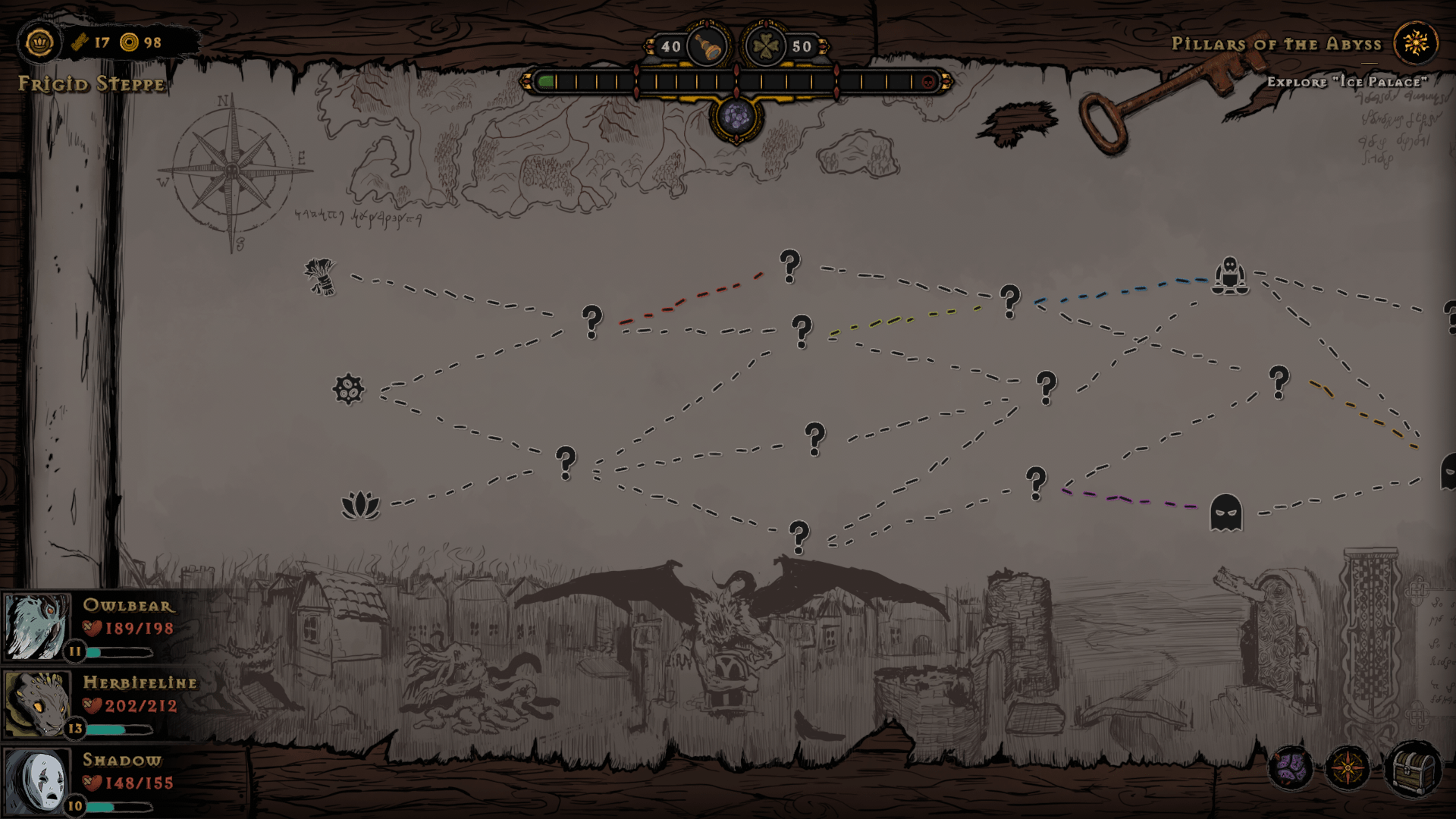
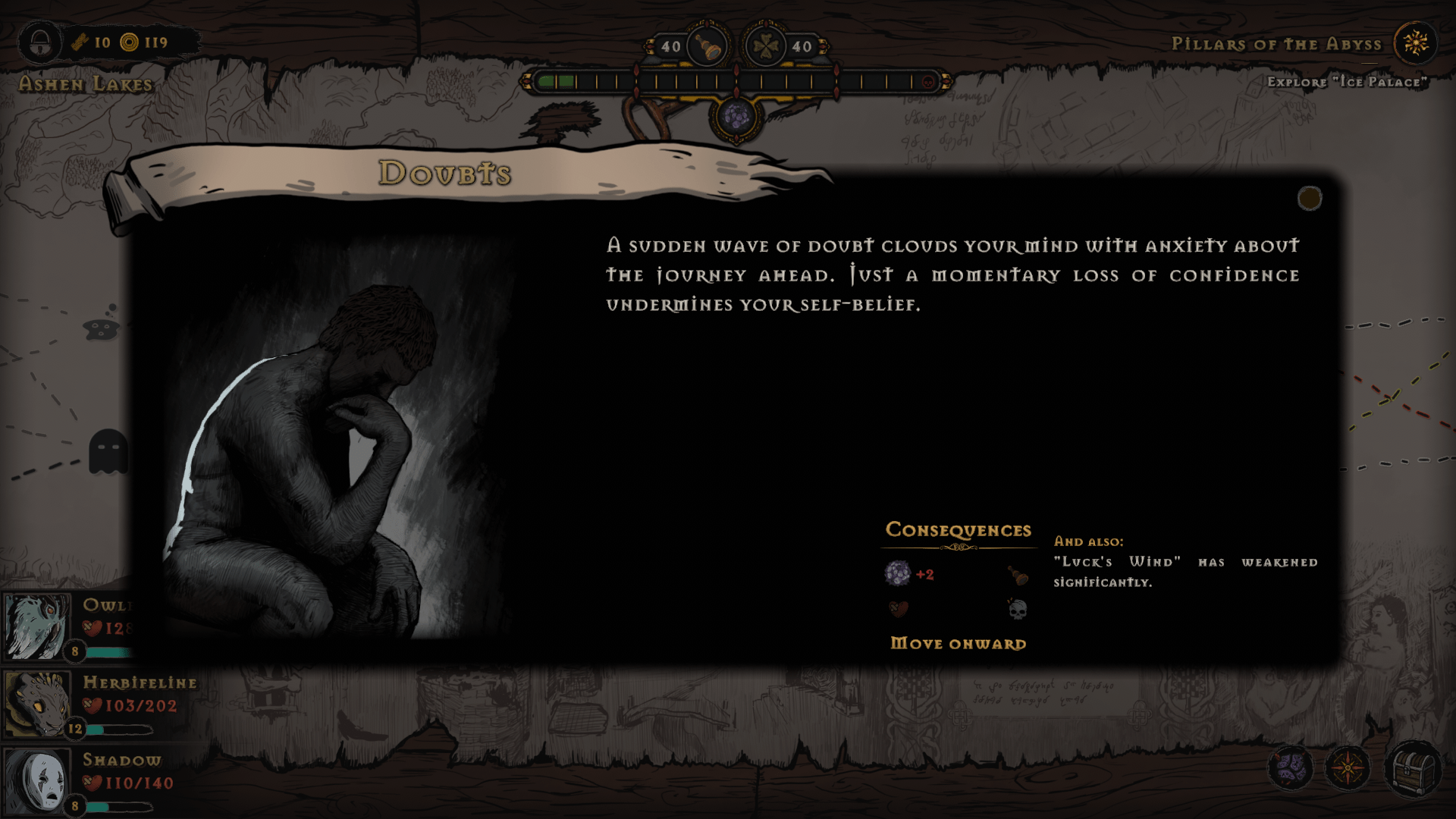
The setup feels rather rote for a dark fantasy game, but I still found myself intrigued to see how it might develop. Lore is mostly delivered via conversations between missions, with occasional events like boss fights capping off arcs in the story. The mission-based structure is one of the first points of differentiation between many of Voidsayer’s contemporaries, as you don’t have a world to freely wander around, but a map full of locations to fast-travel to and a single hub area to visit in between. Likewise, while on an outing, you don’t get to move a character around an area, but instead traverse a randomly-generated Slay the Spire-esque map full of branching and converging paths, each of which meet up at nodes signalling different events. These events could be anything from enemy encounters to resting spots and more, and while some are revealed from the start (and others can be revealed through certain stats and actions as you progress), there are still many times where you’ll have to choose a node with no idea of what it might hold.
You may also find yourself choosing certain paths based on the benefits or drawbacks associated with them, as each normal path you traverse provides a small amount of healing to each member of your party, while coloured paths can do things like doubling that basic healing or increasing the Abyss Distortion. Abyss Distortion in particular is an important stat to manage, as once it reaches certain thresholds, it will begin to stack negative effects onto your journey, making the road forward that much more difficult. Thankfully, some events can reduce it, and it always resets after completing a quest. Lastly, the events you encounter will sometimes specify if an alternate outcome would have been possible under different circumstances, teasing you with future possibilities.
Overall, I’m pretty neutral on the structure of Voidsayer. On the one hand, it stays more focused and requires less bookkeeping than a game that presents you with a world to explore full of NPCs to talk to and side quests to pursue. On the other hand, not knowing exactly what each outing might hold makes it harder to prepare, and the fact that once you set out on a journey, you’re locked in until you either emerge out the other side victorious or die along the way exposes several cracks in the design that I’ll get into more later. For now, it’s just important to note that dying mid-mission reloads your last save from before you left town, meaning there’s no ability to make incremental progress along a mission, return to town to heal and resupply, and then jump back into where you left off. It’s all or nothing, and it makes Voidsayer feel overly punitive instead of engagingly challenging.
Combat in Voidsayer is inevitable, and it’s handled in a turn-based fashion much like the games it draws clearest inspiration from. You select a move for your Entity to perform, the AI secretly selects one for its Entity, and then both creatures get a chance to perform their action, with the one with the higher Speed stat going first. Something I came to appreciate early on is that Voidsayer displays the full stat breakdown for both active Entities at all times, meaning you don’t have to guess or look up stats sheets online to determine who will go first in each round of combat or how equipped items and active effects might impact the outcome. It’s a pleasingly user-friendly approach to a genre that historically likes to dabble in data obfuscation, and being able to quickly and easily crunch the numbers to determine how best to approach a given scenario took some of the edge off an otherwise punishing game. However, an unfortunate omission is that there’s no way to view the stats or moves of your benched Entities when switching one of them in for your active one. This became all the more glaring when a post-launch update overhauled the type system for Entities and replaced them with traits, making the factors at play when going for a switch that much more complex.
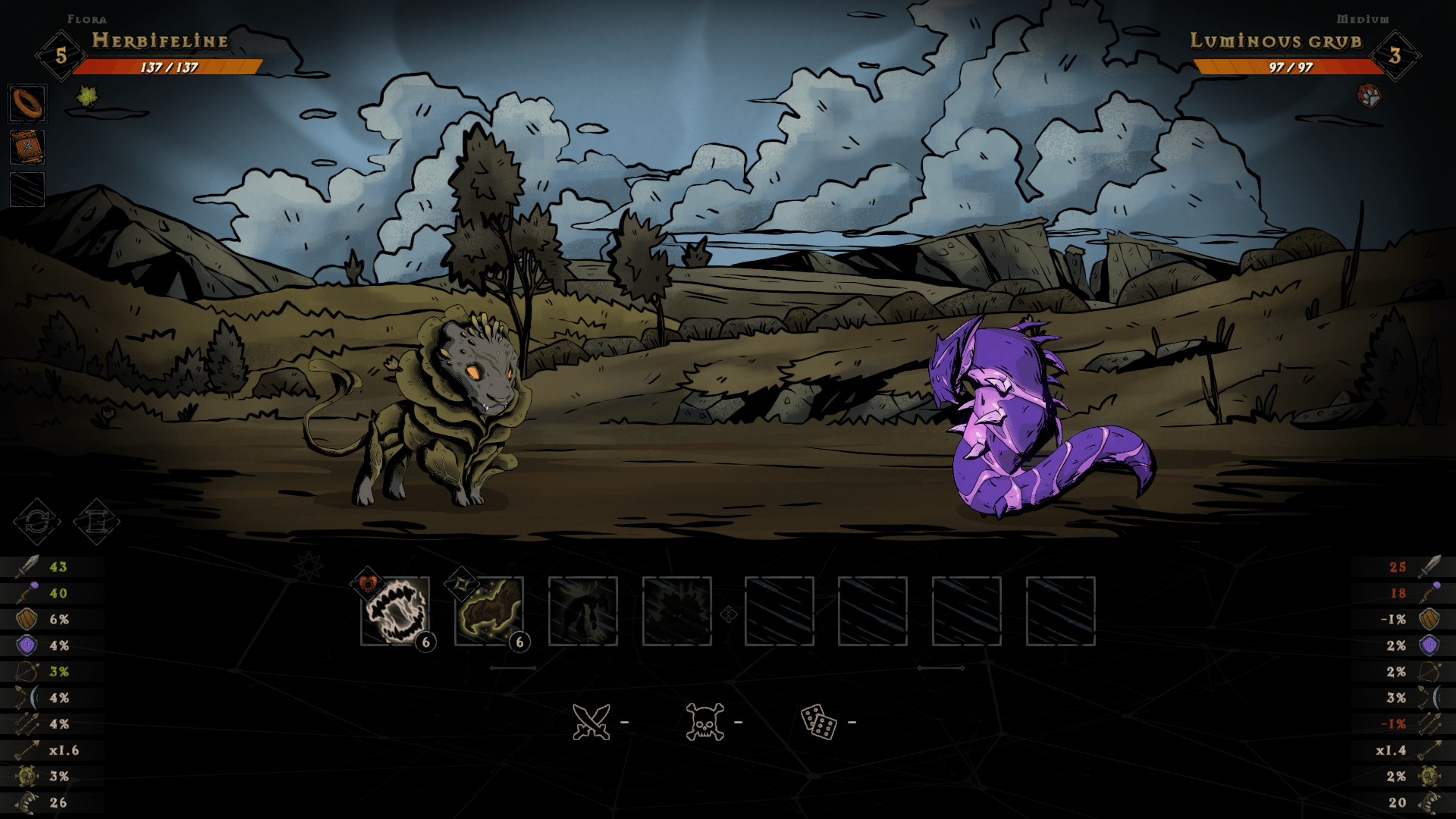
Originally, Voidsayer’s creatures could have up to two types, much like in Pokémon. These types dictated what types of attacks the Entities were strong and weak against, meaning those attacks would deal more or less damage, respectively. Apparently this system was deemed too inflexible for the developers, though, as a few weeks after launch the game was updated to throw out the type system in favour of traits, which are basically passive abilities on Entities. Unlike types, Entities can have any number of traits active at one time, and they can be added or removed by attack effects, held items, etc. The traits still behave much like types in practice (e.g. the Burning trait defines attack types the entity is strong and weak against, status effects it’s immune to, and so on), but there’s potential for an individual Entity to end up with several of them stacking, creating far more complex scenarios in combat. This is a boon for strategy fiends, but as mentioned previously, it makes the times Voidsayer provides incomplete information that much more frustrating to work around. It also means you’ll probably spend a lot more time reading the effects of different traits and analyzing how they interact compared to something like Pokémon, which can easily give Voidsayer a more plodding pace. Pokémon’s lack of in-game information can be a nuisance, but at least a quick web search for a type effectiveness chart will get you the bulk of the information you need to get by for more casual play.
Recruiting new creatures to your squad is a cornerstone of any good creature collector, and Voidsayer is no different. The approach taken here is similar to Pokémon in the sense that there are different tiers of items you can use to capture Entities, with higher tier ones increasing the likelihood of the capture succeeding. Where things differ is that these items (“Sealing Scrolls”, as they’re known in-game) also debuff the enemy’s attack and defense for the rest of the fight, meaning there is an option to use them defensively, even if you’re not looking to recruit your foe. Additionally, once a Sealing Scroll has been used, you just have to defeat the opponent to see if the sealing ritual succeeds, which greatly streamlines the capture system. The downside to this is that you only get one shot to recruit each Entity you encounter, and if the ritual fails, it can feel like a waste of a scroll, even if the debuff made the fight a bit easier. Buying new scrolls requires spending gold that could otherwise be used on healing items and the like, so if the random number generator isn’t on your side (as was the case early on in my playthrough), you can easily find yourself falling behind on resources while trying in vain to diversify your team.

Of course, if you do manage to recruit new Entities, there’s a decent chance they’ll be lower level than your other party members, and it’s here where my biggest issues with Voidsayer come into play. Level grinding is often a key aspect of creature collector games, whether it’s because you’ve hit a boss that you’re underleveled for or simply obtained a cool new critter that you want to utilize in combat. Modern entries in the genre tend to make this more accessible by having a shared party XP system (e.g. all party members gain XP from successful combats, with those that took an active role earning a bit more), items that distribute XP to a specific squadmate even if they didn’t partake (e.g. Pokémon’s Exp. Share item), or even consumable items that simply grant free levels to the creature they’re used on. In my playtime with it, Voidsayer had none of these, and it made level grinding that much more, well, grindy.
I mentioned earlier that if your party falls while on a mission, your save gets reloaded to right before you left for the mission, thus causing you to lose everything you gained on the run, including XP for your Entities. This means that level grinding on higher level quests while you advance the story can be extremely risky, as a few wrong moves (or just some bad RNG) can lead to the whole thing being wasted effort. Of course, logic would then dictate that it’s better to level grind by repeating lower-level quests, but the problem there is that you don’t receive any quest completion rewards on reruns. Since you receive little – if any – gold while trekking through a quest’s encounter map, chances are the spoils from a given journey won’t even be enough to cover the cost of the healing items you used to get through it. And unfortunately, stockpiling healing consumables isn’t an option, because for some inexplicable reason, Voidsayer both limits you to purchasing a maximum of one of each type prior to setting out on a quest and punishes you for bringing more than you need on your journey by throwing out all your leftovers once you complete the quest. Plus, returning to town after successfully completing a mission doesn’t fully heal your Entities, instead only bringing them up to a certain health percentage, so you don’t even get a fully fresh start on each subsequent mission.
This confluence of mechanisms means that the ideal missions for level grinding are ones which are so low-level that you can clear them with your party without the need to purchase any healing items, but since the monsters you fight on these missions are so easy to defeat, they also yield so little XP that equalizing your party levels rapidly becomes an exercise in tedium. Switch training (i.e. putting a lower-level Entity at the head of your party so they get sent out first in combat, then immediately switching them out for a higher-level one, resulting in both Entities gaining XP when the battle is won) also isn’t a great option. At least early on, enemy Entities will regularly take out a tenth or more of your Entity’s health in one hit, even if there’s no weakness at play. Because switch training inherently allows the opponent to get a free hit off on the Entity you’ve just switched in (since you spent your turn switching and not attacking), it’s very easy for your Entities to get rapidly whittled down by this process. Combine this with the fact that you can’t return home to heal whenever you want, and the result is that switch training just makes it far harder to complete the mission (especially without using consumables) and actually keep the XP rewards you’re chasing.
This was what ultimately caused me to burn out on Voidsayer. I reached a point in the game where my character’s mastery level increased, allowing me to have an extra Entity in my party and increasing the level cap for all my Entities. My immediate response was to bring one of the cool new recruits I’d obtained out from storage and get them up to par with the rest of my squad so everyone was ready for the challenges ahead. Unfortunately, I tried and failed multiple times to complete the next story mission with my new team, leading me to return to a medium-difficulty mission instead. However, upon completion I realized that my gold reserves were rapidly drying up thanks to the quest necessitating healing items in order to make it through alive. Suddenly, I was stuck with two options: return to my old party and keep advancing the story to earn more gold, then use that gold to fund level grinding expeditions for my lower-level Entities at the expense of buying higher-value items for my MVPs, or return to a very early mission over and over with the “B-team” and hope that I could stave off boredom long enough to get them where I needed them. Of course, the former would also only work as long as my MVPs remained competitively viable against the new foes I was facing, meaning I could easily be forced into option two if the difficulty curve proved to be too sharp. In the end, I opted for option three: walk away and seek something different to play.
Voidsayer bums me out, because it definitely has potential. It takes steps to both broaden the strategic depth of the classic Pokémon formula, while also making certain aspects more streamlined and accessible. The variety offered by the traits system is really interesting, and I can see some players coming up with truly wild combinations. Plus, I didn’t even get into all the game’s features, like the base-building aspect that allows you to spend resources in town between missions to unlock and upgrade buildings, granting everything from passive buffs and discounts in the shop to increasing the amount that your Entities are healed when you return home. The problem is simply that many of Voidsayer’s mechanisms that are designed to add challenge instead come across as frustrating, tedious, and ill-conceived. Level grinding is rarely considered a fun aspect of RPGs, but here it’s made so finicky and monotonous that it killed my desire to continue playing. The roguelite structure works well for certain types of games, but generally it’s because there’s a level of progress to be made, even if you fail. In Voidsayer, failure means you’ve completely wasted your time, since the randomly-generated mission maps and encounters ensure that an unsuccessful journey can’t even be treated as a scouting expedition. There’s another game I haven’t yet compared Voidsayer to in this review, and that’s the game it takes its (admittedly quite well done) art style from: Darkest Dungeon. Darkest Dungeon is a game I haven’t played, largely because most of what I hear about it is that it’s bleak, punishing, and can often feel like an uphill battle against hopelessness …
… and now that I think about it, perhaps Voidsayer’s similarities to Darkest Dungeon are more than skin deep.
5/10
 Olive's Game Garden